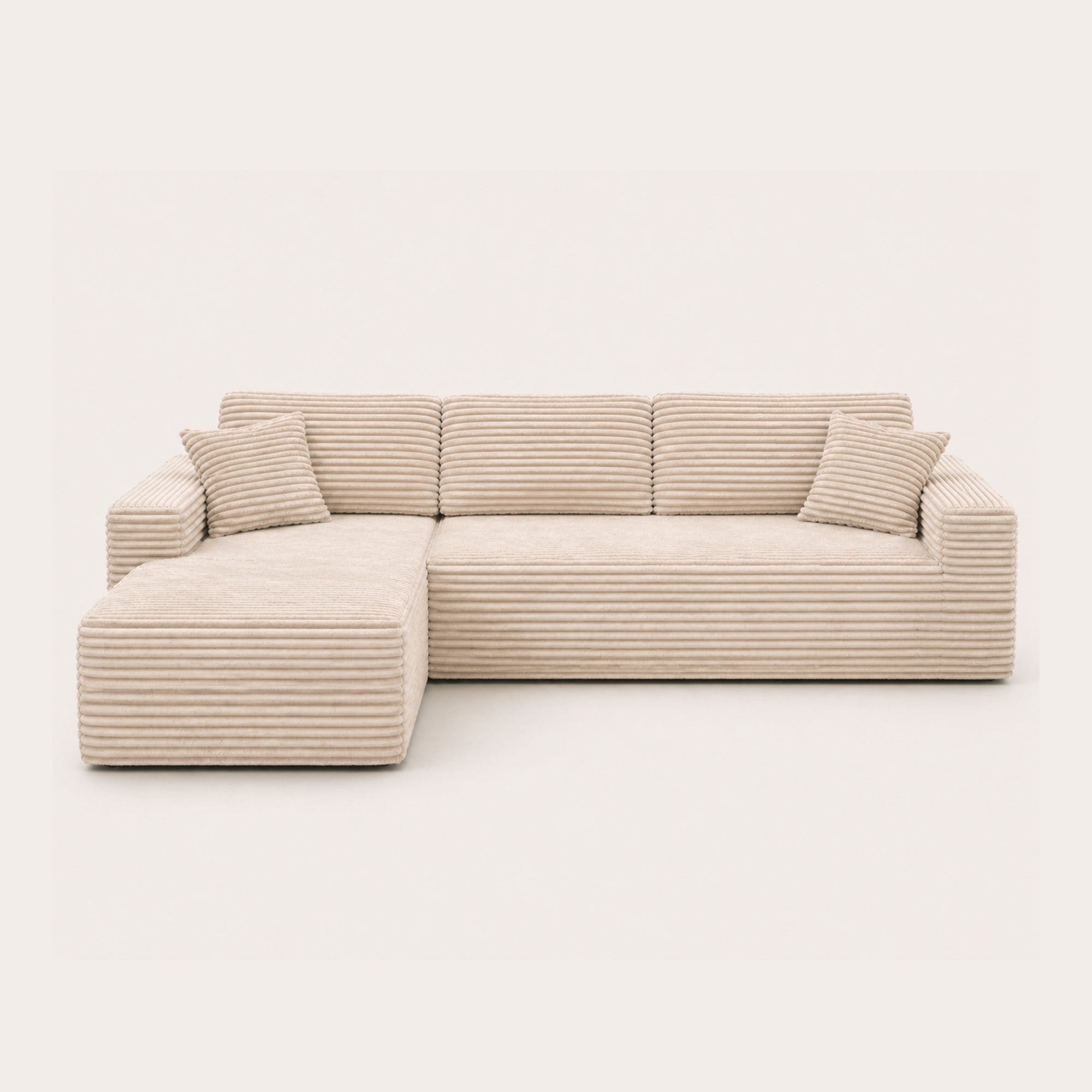


Many young adults make the same mistake: they choose a large, traditional sofa because it seems more comfortable, without realizing that it will overwhelm their living room and complicate their lives during delivery. However, the choice between a compact sofa and a traditional model has a direct impact on layout, daily comfort, and even the logistics of your move. This guide clearly explains the differences between these two types of sofas, their mechanisms, delivery, and value for money, so you can decide with confidence.
Table of Contents
- Understanding the basics: dimensions and structure of compact and traditional sofas
- Mechanical differences: modular, convertible, or fixed?
- Delivery and installation: compressed compacts, the practical revolution
- Comfort, durability, and budget: finding the right balance for your needs
- Case studies and tips: choosing based on space and your needs
- Our perspective: compressed compact, the true innovation for young urban dwellers
- Discover our selections of compact and compressed sofas for your living room
- Frequently asked questions about compact and traditional sofas
Key Points
| Point | Details |
|---|---|
| Customized dimensions | The compact sofa optimizes space without sacrificing style, ideal for small urban living rooms. |
| Simplified delivery | Compressed compacts are easily delivered and set up without stress in small apartments. |
| Balanced comfort and budget | Sleeping quality and accessibility are assured if you choose the right foam density. |
| Adapting to your needs | The choice between compact and traditional depends on size, frequency of use, and lifestyle. |
Understanding the basics: dimensions and structure of compact and traditional sofas
To understand why it's crucial to make the right choice, let's examine the fundamental difference between these two types of sofas.
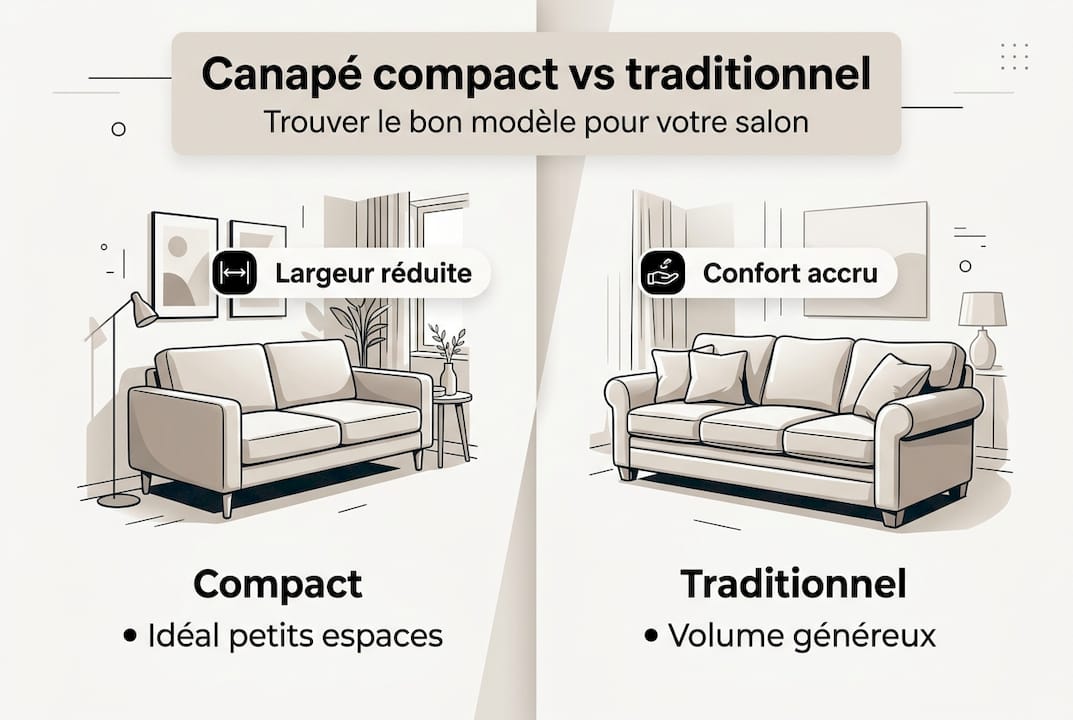
A compact sofa, also known as a space-saving small sofa, generally measures between 130 and 200 cm in width for a 2- to 3-seater model. Its structure is designed to optimize every centimeter: thin or absent armrests, discreet feet, clean lines. This design reduces visual and physical bulk, making it ideal for studios and small apartments. According to Joliplace, compact models are specifically designed for spaces smaller than 15 m².
A traditional sofa, on the other hand, often exceeds 200 to 240 cm in width, with wide armrests and deep seating. It offers undeniable comfort in a large living room, but in a small space, it can block circulation and give a cramped feeling. Le Journal de la Maison highlights that placing a standard sofa in a small living room is one of the most common mistakes in interior design.
Quick comparison of the two types:
| Criterion | Compact sofa | Traditional sofa |
|---|---|---|
| Average width | 130 to 200 cm | 200 to 240 cm |
| Armrests | Thin or absent | Wide and padded |
| Suitable for small spaces | Yes | No |
| Average weight | 30 to 50 kg | 60 to 100 kg |
| Ease of delivery | Very good | Difficult |
To learn more about current trends, consult our article on the compact sofa 2026. If you're still unsure about aesthetic criteria, our guide to choosing an elegant sofa can help you narrow down your choice.
Simple rule: if your living room is less than 20 m², a compact sofa will almost always be the best option.
Mechanical differences: modular, convertible, or fixed?
Having identified the physical aspects, let's look at the mechanisms that truly distinguish the two types of sofas.
Compact sofas often come in convertible versions, with two main systems: the BZ and the clic-clac. The clic-clac unfolds into two positions (reclined or flat) with a simple push. The BZ, on the other hand, requires removing the cushions and pulling the frame forward to reveal a real mattress. The latter generally offers better sleeping comfort. According to KingsCanapé, quality BZ systems last an average of 8 to 10 years with regular use, compared to 5 to 7 years for entry-level clic-clacs.
To better understand the nuances between these mechanisms, the details on BZ and clic-clac systems are very useful before purchasing.
Which mechanism to choose based on your usage?
- Daily use as a bed: opt for a BZ with a thick mattress (minimum 12 cm)
- Occasional guests: a compact clic-clac is more than sufficient
- Modular living room: a compact corner sofa with a chaise lounge offers more flexibility
- Small studio: prioritize a compressed compact convertible for easier delivery
Traditional sofas, however, are rarely convertible. Their massive structure does not easily lend itself to transformation. They are fixed, often very comfortable for sitting, but useless if you need extra sleeping space.
Pro tip: before buying a convertible, test the mechanism in-store or check customer reviews on the smoothness of opening. A stiff mechanism from the start will not improve over time.
Our compact vs. classic sofas guide details these differences with concrete examples for each buyer profile.
Delivery and installation: compressed compacts, the practical revolution
Beyond comfort or style, logistics can change everything. Let's see how delivery differs depending on the type of sofa.
Delivering a traditional sofa to a Parisian apartment building without an elevator is often a nightmare. Delivery drivers sometimes refuse to go beyond the second floor, and carrying fees can reach an additional 100 to 150 euros. Compressed sofas completely change the game.

A compressed compact sofa is delivered in a compact box, transportable by a single person, even up a narrow staircase. Once unboxed, the foam expands in 24 to 72 hours to regain its final shape. No need for specialized delivery personnel or a furniture lift.
Concrete advantages for urban living:
- Delivery possible to any apartment, even on the 6th floor without an elevator
- No additional carrying fees
- Installation in less than 30 minutes without tools
- Easy returns if the product is not suitable
- Reduced carbon footprint thanks to optimized transport
Pro tip: after receiving your compressed sofa, leave it in a room at ambient temperature (at least 18°C) to speed up foam expansion. Cold slows this process down.
However, there are a few points to watch out for. The foam absolutely needs time to expand before use, otherwise the sofa may deform. You also need to check the quality of the foam before buying: too low a density will result in a disappointing outcome after expansion.
To learn all about this process, our compact sofa delivery guide answers all your questions. And if you want to understand the technology behind it all, the article on compressed sofa technology is an essential read.
Comfort, durability, and budget: finding the right balance for your needs
While practicality is a real plus, the choice should not come at the expense of your sofa's comfort or durability.
Foam density is the number one criterion for evaluating a sofa's comfort and longevity. For daily use as a seat, a density of 30 to 35 kg/m³ is recommended. For regular use as a bed, aim for 35 to 40 kg/m³ minimum. Below 25 kg/m³, the foam sags quickly and the sofa loses its shape in less than two years.
According to La Maison du Convertible, a well-chosen compact sofa can offer comfort equivalent to a traditional model if the foam exceeds 32 kg/m³ and the mattress thickness reaches at least 10 cm.
Key points for assessing quality:
- Foam density above 30 kg/m³ for the seat
- Sleeping mattress of at least 12 cm for regular use
- Resistant upholstery (corduroy, stain-resistant fabric)
- Solid wood legs rather than plastic
- Manufacturer's warranty of at least 2 years
Pro tip: beware of prices that are too attractive below 400 euros. A good quality compressed compact sofa costs between 500 and 700 euros. Below that, you risk poor density foam that will sag quickly.
The foam and durability recommendations confirm that low-end models often show premature wear issues at the folds and convertible mechanisms. To make a truly smart purchase, our durable sofa guide and compressed sofa reviews will give you all the keys.
Case studies and tips: choosing based on space and your needs
You now have the keys to make an informed choice: let's see together how to decide based on your own setup.
Every situation is different, and the right sofa depends as much on your space as on your lifestyle. Here's how to adapt your choice based on your profile.
Recommendations by configuration:
- Studio or 1-bedroom apartment (less than 20 m²): choose a compressed compact convertible BZ sofa. It serves as a sofa during the day and a bed at night, without cluttering the space.
- 2- or 3-room apartment (20 to 40 m²): a compact 3-seater corner sofa is ideal. It structures the living room without saturating it and offers enough space for several people.
- Large living room (more than 40 m²): you can consider a traditional sofa, but a well-chosen compact corner sofa is often more aesthetic and easier to move if you relocate often.
- Shared accommodation: opt for a sturdy model with easy-to-clean upholstery and a solid convertible mechanism to accommodate friends.
- Family with children: prioritize stain-resistant fabric and stable legs, compact or traditional depending on the available space.
According to Joliplace, experts recommend leaving at least 60 to 80 cm of circulation space around the sofa to ensure a pleasant and functional living area.
Pro tip: before buying, outline the perimeter of your future sofa on the floor with adhesive tape. You'll immediately visualize if the size is suitable for your space and if circulation remains fluid.
Our compact sofa user guide walks you through setting up your new sofa in the best conditions.
Our perspective: compressed compact, the true innovation for young urban dwellers
Stepping back from objective criteria, here's the perspective we want to share with you.
Many articles compare compact and traditional sofas on paper, but forget the essential: the daily reality of a young adult in the city. Moving often, living in 30 m², hosting friends without having an apartment designed for it... these are very real constraints that a traditional sofa simply does not solve.
The compressed compact sofa is not a compromise. It's an intelligent response to a modern lifestyle. The real question is not "is it as good as a traditional one?", but "is it adapted to my life?". And for the vast majority of young urban dwellers, the answer is yes.
What many forget to mention is after-sales service. A quality compressed sofa must be accompanied by responsive support in case of expansion issues or foam defects. This is as important a criterion as density itself. Beware of brands that disappear after the sale.
Also avoid vacuum-packed sofas that promise wonders with overly light foams. Technological innovation does not compensate for poor material quality.
Discover our selections of compact and compressed sofas for your living room
If you're looking for a practical solution, explore our selection designed for small spaces and urban living.
At Joya Home, we've designed a range of compressed sofas that perfectly meet the needs of young adults in France: compact box delivery, tool-free installation, high-density foam, and a refined corduroy design. Our models like Le Méridia and Le Reverso combine aesthetics and practicality, with fast delivery directly to your home.
To understand everything about this technology, visit our page dedicated to compressed sofas. And if you'd like to browse our entire range, discover our innovative sofas designed to combine comfort, style, and ease of delivery. Your living room deserves better than a sofa that complicates your life.
Frequently asked questions about compact and traditional sofas
Is a compact sofa as comfortable as a traditional one?
A modern compact sofa offers very good comfort if the foam quality exceeds 30 kg/m³, but massive traditional models can offer slightly more enveloping seating due to their depth.
Can you sleep every day on a compact sofa?
Yes, provided you choose a high-end BZ type model with a density greater than 35 kg/m³, as recommended by KingsCanapé to ensure long-term comfort and durability.
How long should you wait after a compressed sofa is delivered?
The foam takes between 24 and 72 hours to regain its full shape after unpacking, depending on the room temperature and material density.
What is the average price of a compressed compact sofa?
A good quality model costs between 500 and 600 euros, delivered in a compact box, which remains very competitive compared to traditional sofas of the same comfort level.
What risks should be avoided with a compact sofa?
Very low-end models present risks of premature wear in the fabric folds and the convertible mechanism, especially with intensive daily use.
Recommendation
- Compact Sofa 2026: +70% space & retro comfort – Joya Home
- Differences between compact and classic sofas: 2026 guide – Joya Home
- Compact sofa: easy user guide for living rooms 2026 – Joya Home
- Essential criteria for choosing an elegant apartment sofa – Joya Home
- How to Choose Upholstered Fabrics for Your Home – Shop Designer Fabrics by the Yard | Curtains & Drapery