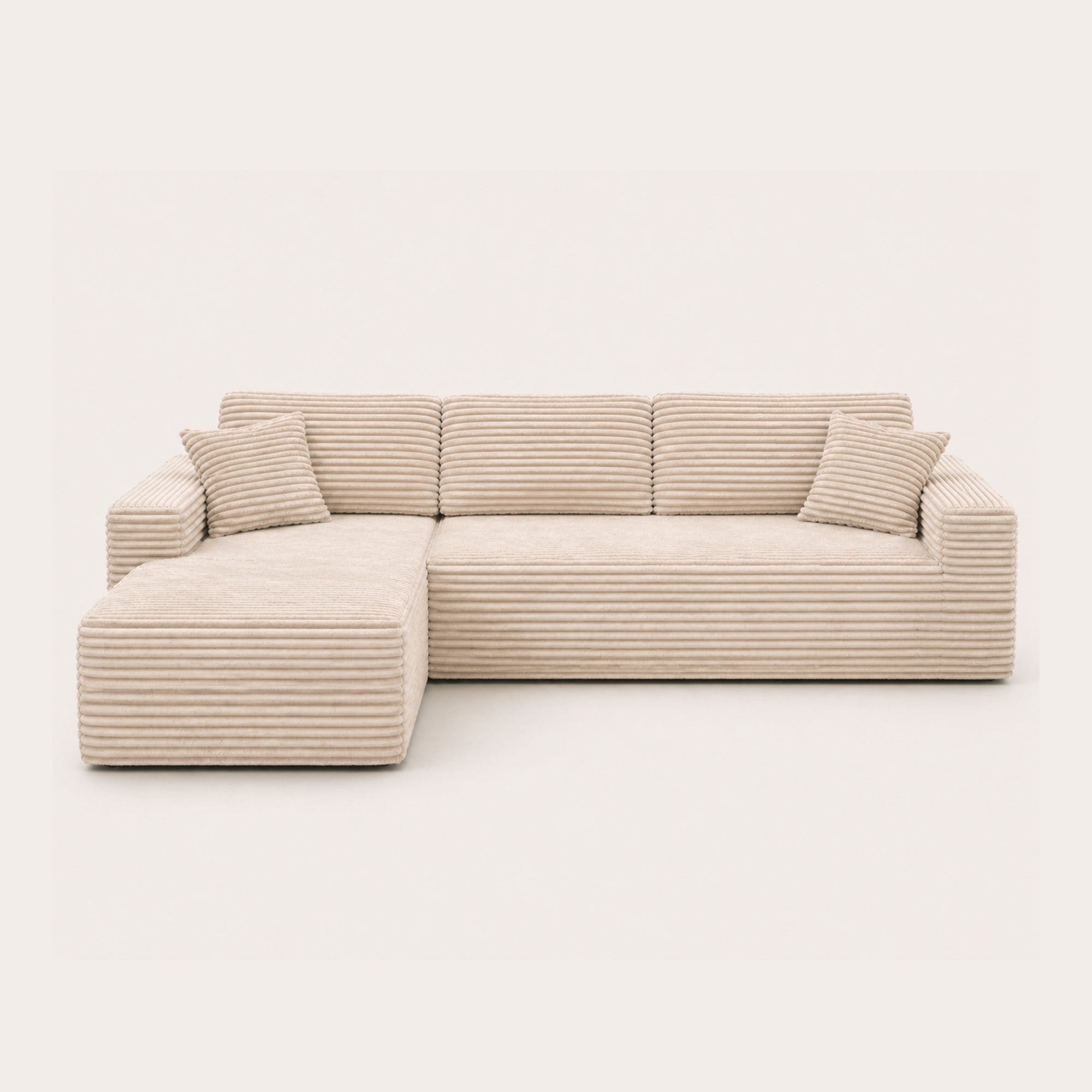

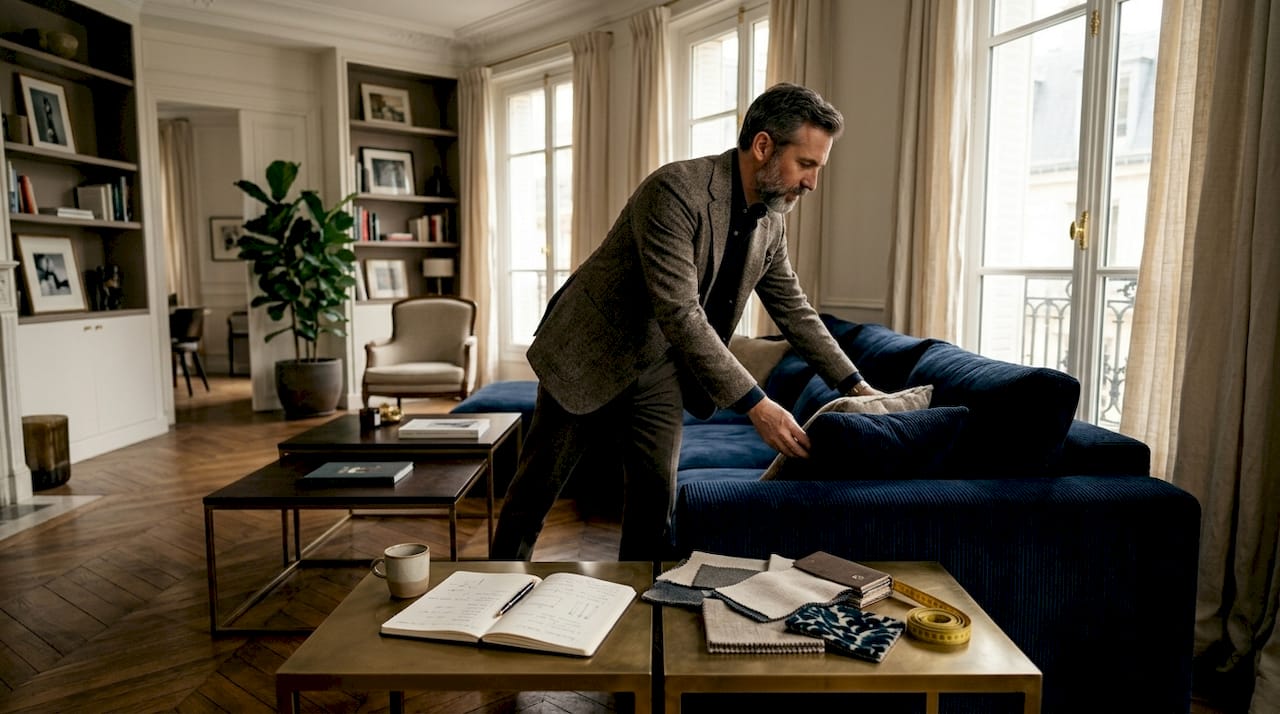
A high-end sofa isn't just for magazine interiors or unlimited budgets. For a young adult looking to create a living room that's stylish, comfortable, and easy to live with, understanding what truly differentiates a premium sofa changes everything. The right criteria are concrete, measurable, and often more accessible than you might think. Here's what you need to know to choose wisely, without getting lost in jargon.
Table of Contents
- What is a high-end sofa?
- Materials and comfort: the heart of quality
- Retro styles and innovative features
- Modular, convertible, and stress-free installation
- Our advice for choosing according to your use
- Discover our selection of high-end sofas adapted to your style
- Frequently asked questions about high-end sofas
Key Points
| Point | Details |
|---|---|
| Premium materials | A high-end sofa relies on solid wood, high-resilience foam, and certified fabrics for unmatched comfort and durability. |
| Density and maintenance | A foam density greater than 35 kg/m³ is the decisive criterion for daily use and true longevity. |
| Retro shapes, easy assembly | Retro models combine modularity, ease of installation, and a chic look, ideal for limited spaces. |
| Smart investment | Choosing a high-end sofa guarantees 8 to 15 years of comfort while enhancing your interior. |
What is a high-end sofa?
The term "high-end" is often misused to justify a high price. But in reality, a high-end sofa meets precise and verifiable criteria. It's not a question of brand or storefront; it's a question of composition.
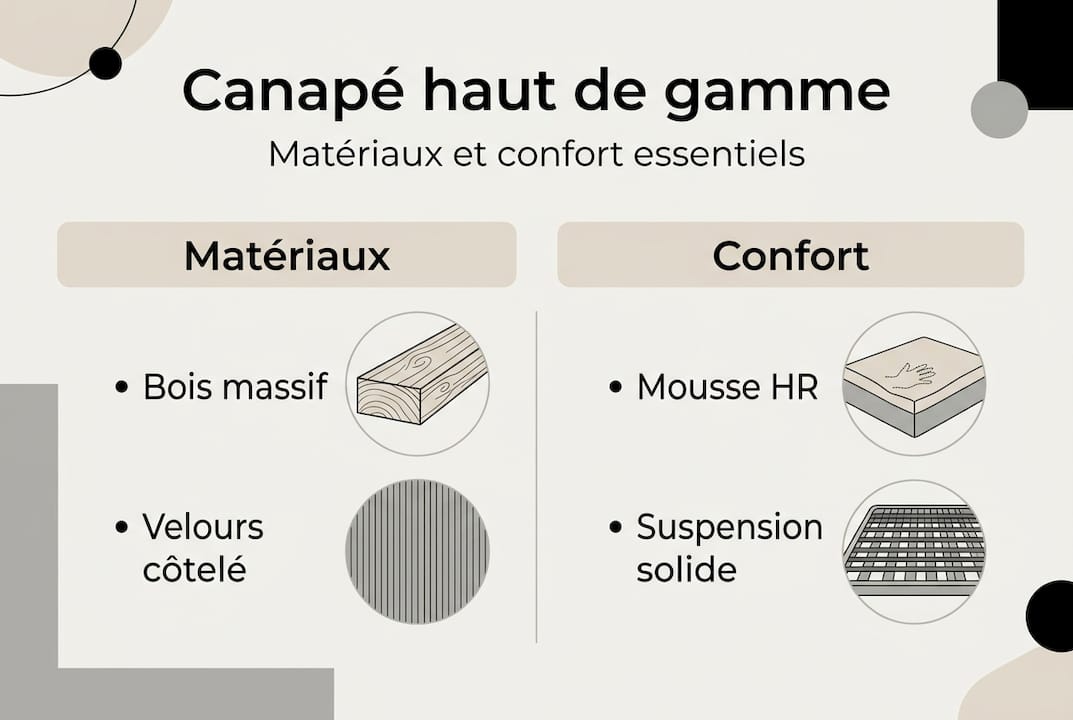
A high-end sofa is distinguished by certified noble materials: full-grain leather, Italian velvet, Oeko-Tex certified stain-resistant fabrics, solid wood or reinforced metal frames, and high-resilience (HR) foam padding with a density of 35 to 45 kg/m³ minimum. These elements are not aesthetic details; they directly determine your daily comfort and the lifespan of the furniture.
"The difference between a standard sofa and a high-end sofa is felt from the first few weeks: the seat remains firm, the seams hold, and the fabric retains its texture. It's an investment that pays off over time."
For those interested in corduroy, our corduroy practical guide details why this fabric is particularly suited to retro modern interiors. You can also explore corduroy decor ideas to visualize the possibilities in a real living room.
Here are the observable criteria of a true high-end sofa:
- HR foam with a density of 35 to 45 kg/m³ minimum
- Frame made of solid wood or reinforced metal
- Fabric certified Oeko-Tex or full-grain leather
- Reinforced seams and meticulous finishes
- Solid wood or metal legs, not hollow
- Removable covers for easy maintenance
If you want to compare luxury sofa references, you will consistently find these criteria, regardless of the brand.
Materials and comfort: the heart of quality
Once the definition is established, let's look concretely at what this implies for the composition and comfort of a high-end sofa. The most determining material, one that you don't see but feel immediately, is the foam.
High-resilience (HR) foam is a foam whose density is measured in kg/m³. The higher this number, the more the foam resists repeated compression. According to the convertible expert guide, a density of 35 to 45 kg/m³ is the high-end standard, compared to 25 to 30 kg/m³ for common models. The mattress thickness follows the same logic: 13 to 18 cm for premium, versus 6 to 10 cm for entry-level.
| Criterion | High-end | Standard |
|---|---|---|
| Foam density | 35 to 45 kg/m³ | 25 to 30 kg/m³ |
| Mattress thickness | 13 to 18 cm | 6 to 10 cm |
| Frame | Solid wood or reinforced metal | Chipboard or plastic |
| Fabric | Oeko-Tex certified, velvet, leather | Non-certified polyester |
| Estimated lifespan | 8 to 15 years | 3 to 5 years |
Pro tip: Before buying, always ask the salesperson for the foam density. If the information is not available or if it is less than 35 kg/m³, move on for daily use.
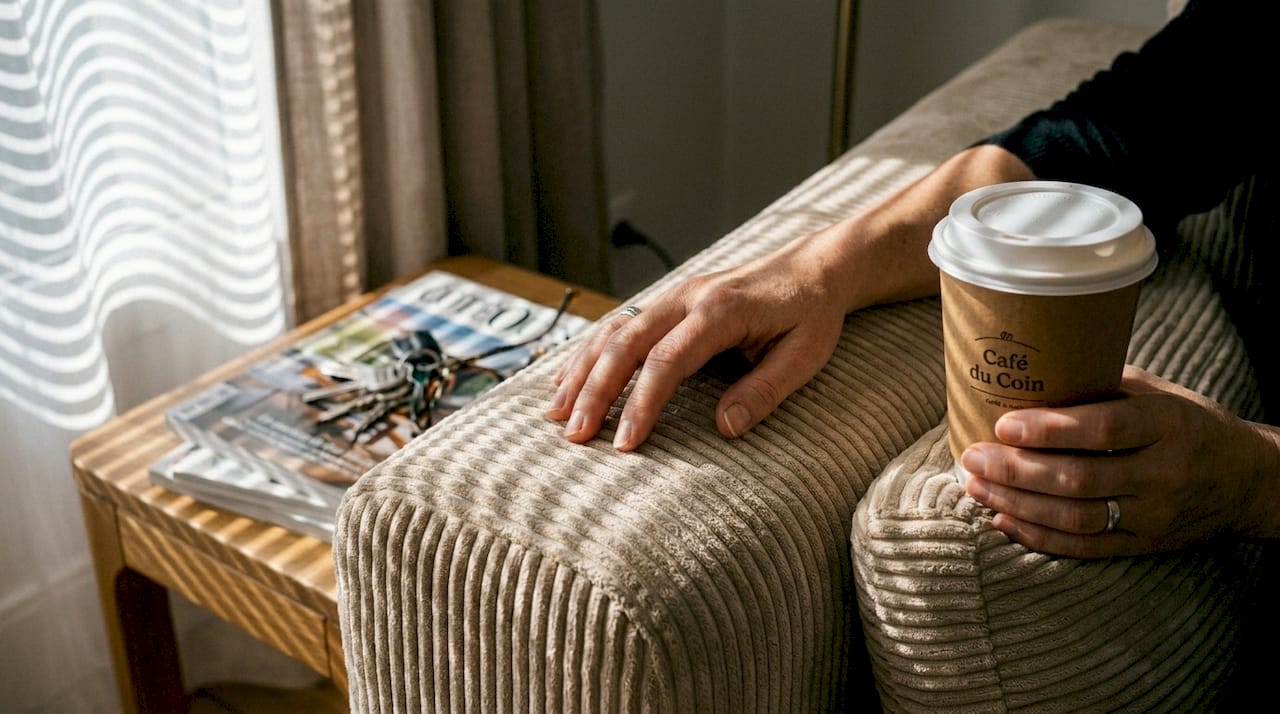
Corduroy deserves a special mention. This fabric combines a rich visual texture with superior wear resistance compared to many smooth fabrics. It's also easier to maintain than you might think. Our corduroy maintenance guide explains how to preserve its texture and color long-term.
Retro styles and innovative features
Once the foundation of comfort is understood, let's look at how high-end meets retro spirit and active living. Retro style isn't just about a color or an era. It relies on precise codes that can be identified and reproduced.
Characteristic visual elements of high-end retro are corduroy, tufting (those small buttons or raised seams that structure the backrest), cylindrical walnut legs, and dense bouclé fabrics. These details immediately create a warm and refined atmosphere, even in a small apartment. To delve deeper into this topic, our article on compact retro comfort shows how to maximize visual impact in a small space.
"Tufting and walnut legs are not just decorative: they signal meticulous craftsmanship and attention to detail that is found throughout the sofa's construction."
But today's retro style also incorporates modern features. Retro modular sofas use invisible metal or velcro fastening systems, modules heavy enough to remain stable without floor fixing, and removable, machine-washable covers. This is the winning combination for an active apartment.
Here are the features to prioritize for a retro sofa adapted to apartment living:
- Removable modules machine-washable (essential with pets or children)
- Invisible fasteners between modules for a clean assembly
- Adjustable legs to compensate for uneven floors
- Adjustable seat depth depending on the room configuration
- Timeless colors (sage green, terracotta, duck egg blue) to adapt to trends without going out of style
To harmonize your sofa with the rest of your decor, consult our guide to harmonizing velvet decor and creating a cohesive living room.
Modular, convertible, and stress-free installation
Now that you've visualized the ideal retro sofa, let's see how modularity and convertibility transform your daily life. These two options address different needs, and confusing them can lead to a bad purchase.
A classic convertible sofa unfolds into a bed thanks to an integrated mechanism. High-end mechanisms like Rapido or Lampolet allow the bed to be unfolded without removing the cushions, are tested for over 10,000 cycles, and offer a minimum 5-year warranty. A modular sofa, on the other hand, is composed of independent sections that you assemble according to your space.
| Criterion | Classic convertible | Clip-on modular |
|---|---|---|
| Primary use | Regular sleeping | Flexible configuration |
| Installation | Standard delivery | Tool-free assembly |
| Retro design | Possible | Very suitable |
| Average budget | €800 to €2,000 | €600 to €1,800 |
| Durability | 8 to 15 years (solid wood) | 8 to 12 years |
To install a modular sofa stress-free, here are the concrete steps:
- Clear the space before unpacking the modules to avoid unnecessary movement.
- Identify the modules (corner, chaise lounge, single seat) and their orientation before assembling.
- Connect the fasteners starting with the corner or angle, which serves as an anchor point.
- Check the stability of each joint before placing the cushions.
- Adjust the feet if the floor is uneven to prevent wobbling.
Pro tip: Make sure the fasteners between modules are securely locked after each move. A poorly secured module can slip and damage the fabric or frame in the long run.
If you're looking for an even simpler solution, our article on the compressed sofa explains how this technology makes delivery and assembly accessible to everyone. For small spaces, our quick assembly for small spaces page offers adapted solutions. To learn more about choosing a convertible, this convertible sofa test compares the most common mechanisms.
Our advice for choosing according to your use
To summarize all these criteria, here is a simple method to prioritize what really matters in your choice. Too many people start with style and end up regretting their purchase due to comfort or maintenance.
Here is the recommended order of priority:
- Seating comfort: check the foam density. Below 35 kg/m³ for daily use, you risk sagging in less than 5 years.
- Modularity: does the sofa adapt to your current space AND a future move?
- Maintenance: are the covers removable and washable? Is the fabric stain-resistant?
- Budget: consider it an investment over 10 years, not a one-time expense. A €1,200 sofa that lasts 12 years costs €100 per year.
- Style: choose last, once the functional criteria are validated. Retro style is timeless; it won't go out of fashion.
A well-chosen high-end sofa doesn't need to be replaced every 3 years. That's exactly what makes it economical in the long run. To compare options based on your profile, our guide compact vs. classic sofa comparison helps you decide based on your space and habits.
Discover our selection of high-end sofas adapted to your style
You now know what distinguishes a true high-end sofa: foam density, fabric quality, frame sturdiness, and ease of installation. At JOYA Home, every model is designed to meet these exact criteria, with a special focus on retro style and practicality for young adults in apartments.
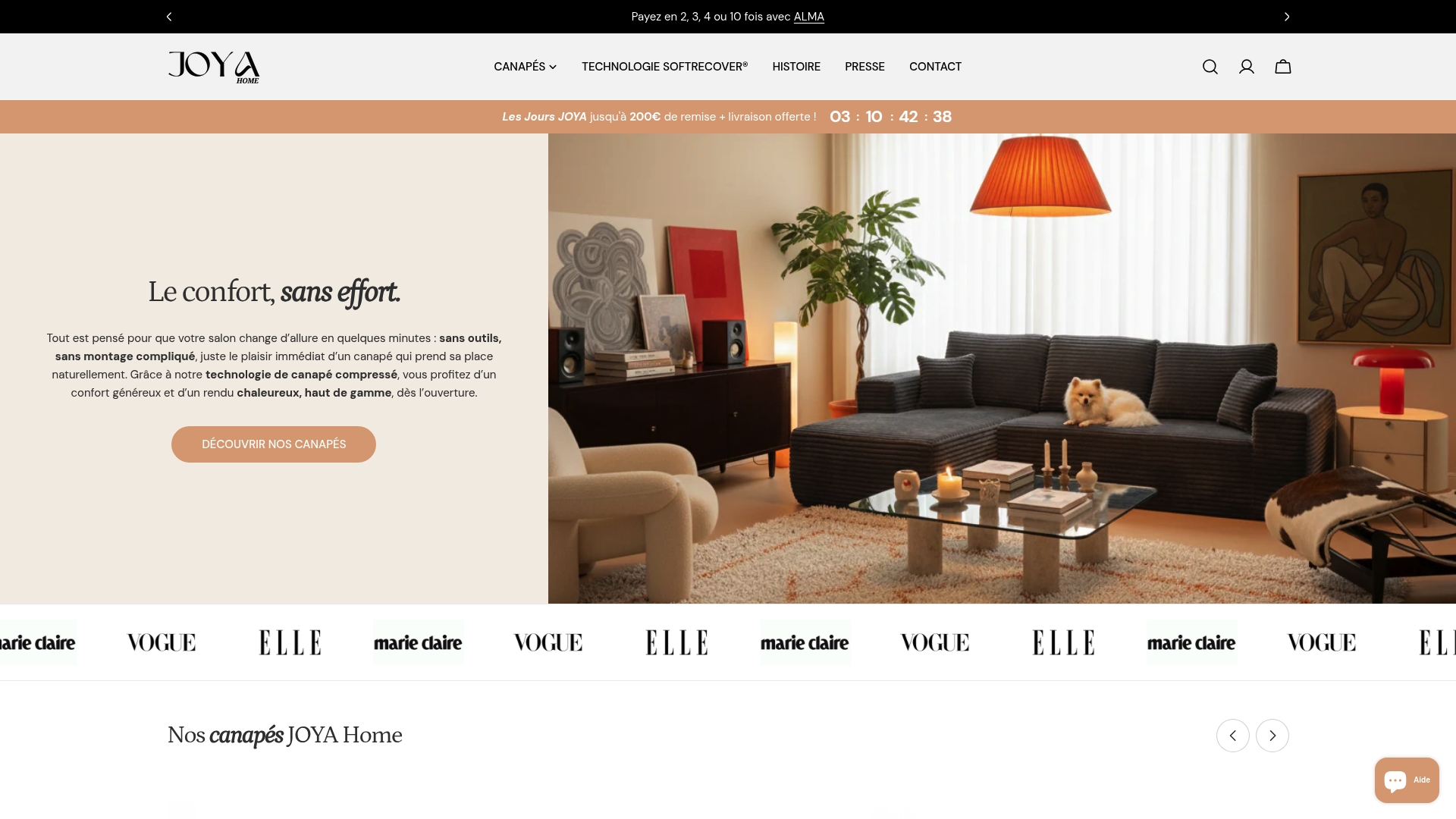
Our corduroy sofas, like Le Méridia and Le Reverso, combine HR foam, a sturdy frame, and compressed technology delivery: they arrive at your home in a compact box, without a moving truck or installation team. Discover quality at JOYA Home, explore the advantages of the compressed sofa, and browse our design selection to find the model that fits your space and style.
Frequently asked questions about high-end sofas
What foam density should I choose for a high-end sofa used daily?
Opt for high-resilience foam of at least 35 kg/m³ for durable daily use. Below this threshold, the seat risks sagging in less than 5 years.
How do I maintain a high-end fabric sofa?
Use a soft-brush vacuum cleaner weekly and opt for removable, machine-washable covers for easy maintenance. Corduroy can be easily reshaped with a soft brush after washing.
Can a high-end modular sofa be installed alone?
Yes, modern modules assemble without complex tools thanks to invisible metal or velcro fasteners. Most assemblies can be done in less than 30 minutes with two people.
What is the lifespan of a high-end sofa?
A well-chosen and maintained model generally lasts between 8 and 15 years, especially thanks to a solid wood frame and high-resilience foam resistant to repeated compression.