
TL;DR:
- Proper space preparation, including measuring and outlining, prevents traffic issues with your sofa. It's crucial to analyze the layout, maintain a walkway of at least 76 cm, and disassemble removable parts for easy moving. Modular arrangements and compact solutions optimize even small living rooms, ensuring comfort and fluidity.
You've ordered a beautiful sofa, it arrives tomorrow, and suddenly you realize you've never really measured if the passage from the entrance is sufficient. Worse yet, once placed, the sofa blocks half the living room and makes every movement difficult. This scenario is much more common than one might think, yet a few simple steps can prevent it. In this article, you will discover a concrete method for preparing your living room before installation, respecting proper distances, and transforming even a small space into a fluid and pleasant relaxation area.
Table of Contents
- Preparing Your Space: Prerequisites Before Installing a Sofa
- Key Steps: How to Concretely Prepare Your Space
- Optimizing Flow and Final Layout
- Mistakes to Avoid and Alternative Solutions
- Our Opinion: Sofa Arrangement, More Than Just Centimeters
- Space-Saving Solutions for an Optimized Living Room
- Frequently Asked Questions About Sofa Space Preparation
Key Points
| Point | Details |
|---|---|
| Passage Respect | Always leave 76 to 91 cm clear around the sofa for smooth circulation. |
| Methodical Preparation | Anticipate obstacles and disassemble removable parts for stress-free installation. |
| Essential Rug Tips | A well-placed rug should extend 30 cm beyond each side and be kept non-slip. |
| Evolving Optimization | Feel free to regularly review the living room layout to maintain a functional space. |
Preparing Your Space: Prerequisites Before Installing a Sofa
Having understood why space preparation is crucial, let's look at how to start the project. Before moving any furniture, you need to gather the right materials and take the time to objectively analyze your room.
Essential Equipment
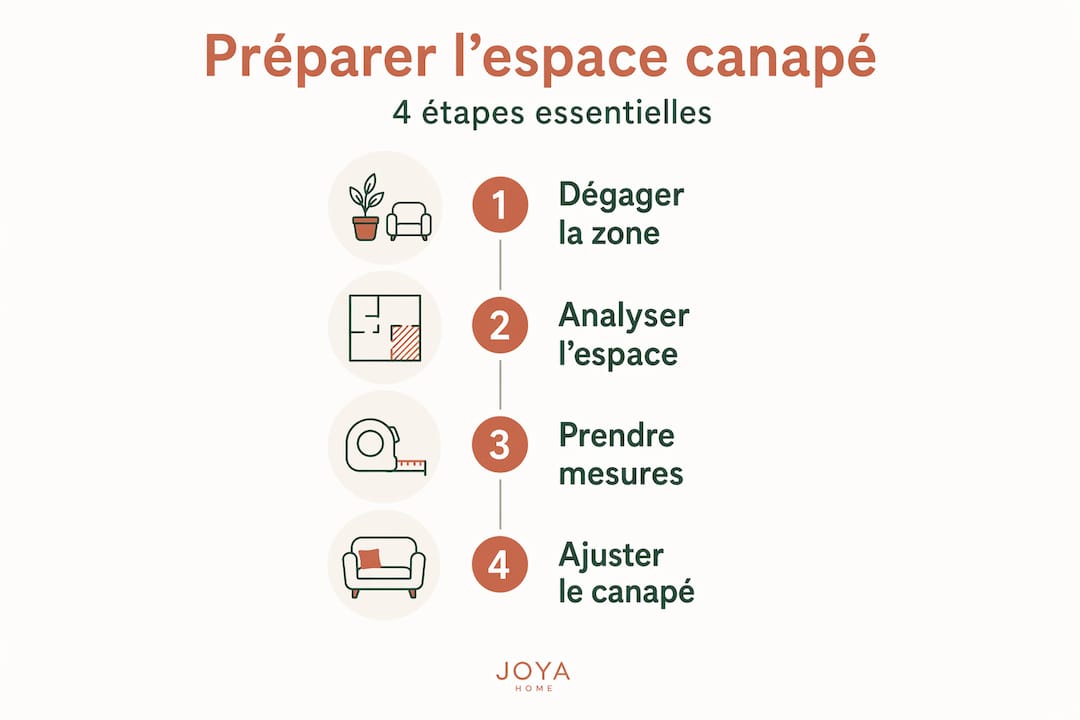
Here's what you need before you start:
- A tape measure (minimum 5 meters)
- A spirit level to check the flatness of the floor
- An erasable marker or painter's tape
- A screwdriver to remove sofa legs if necessary
- A non-slip rug pad if you plan to lay a rug
| Tool | Primary Use | Essential? |
|---|---|---|
| Tape measure | Measure distances and passages | Yes |
| Adhesive tape | Outline the space on the floor | Yes |
| Spirit level | Check floor stability | Recommended |
| Screwdriver | Remove legs | Depends on model |
| Rug pad | Stabilize the rug | If rug planned |
Analyzing the Room Configuration
Before moving anything, observe your living room with fresh eyes. Identify fixed obstacles: radiators, windows, swinging doors, electrical outlets. These elements define areas where you simply cannot place your sofa without creating a functional problem.
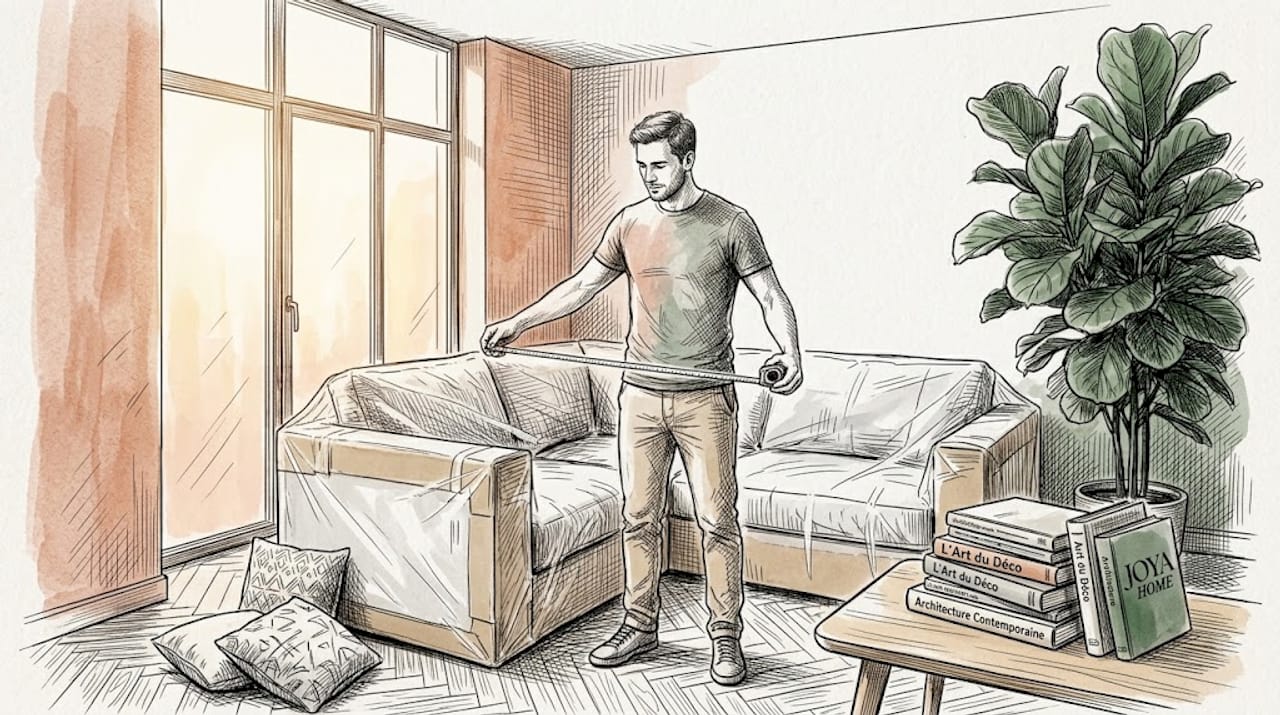
The concept of a walkway (free space allowing movement without obstruction) is central to any living room arrangement. According to recognized rules, you should allow 76 to 91 cm around the sofa for comfortable circulation. Below 76 cm, passage becomes uncomfortable and even dangerous in an emergency.
The 3-2-1 method is an excellent approach to structuring your living room layout based on the actual proportions of the room. Take the time to read this resource even before purchasing your sofa.
Pro Tip: Outline the exact silhouette of your future sofa on the floor with painter's tape. Live with this outline for a whole day. If you constantly bump into the limit or instinctively go around the perimeter, it's a sign that the chosen model is too large for this space.
Key Steps: How to Concretely Prepare Your Space
Once the prerequisites are met, it's time to take action with a clear, step-by-step method. Don't rush anything: a good layout is prepared before the sofa even crosses the threshold.
-
Measure all openings: front door, hallway, stairwell, living room door. Compare these with the sofa's delivery dimensions, not just its final dimensions.
-
Outline the target location on the floor: Use your adhesive tape to mark the width and depth of the sofa exactly where you want to install it. Include the depth of any legs or chaise lounge elements.
-
Disassemble removable elements before moving the furniture. As recommended by MovingPlace, removing cushions and legs significantly reduces bulk and facilitates passage through narrow spaces. This also applies to removable chaise lounges on sectional sofas.
-
Identify the widest area of your living room if space is constrained. If you're working with a hallway or stairs, always measure two distinct passage points: the narrowest and the rotation point necessary for maneuvering.
-
Position the sofa progressively: Don't just permanently place it on the first try. Move it into the room, step back, and observe the remaining space from all possible angles.
-
Reassemble the disassembled elements only once you are satisfied with the overall positioning.
Pro Tip: Always store screws, legs, and small parts in a labeled plastic bag with the furniture's name. Tape this bag under the sofa with double-sided tape. This will prevent you from losing essential parts during a future move.
For detailed advice on assembly itself, consult our guide for installing a sectional sofa or our article on easy-to-assemble sofas if you are looking for a model with simplified assembly.
“The biggest risk when moving a sofa is not the sofa itself, but the fixed obstacles that were not anticipated.”
Optimizing Flow and Final Layout
After preparation and physical installation, it's time to think about the overall layout and balance of the living room. Is the sofa's positioning validated? Perfect. Now it remains to integrate it into the visual and functional logic of the room.
Compact Sofa or Deep Sofa: What Impact on Circulation?
| Configuration | Typical Depth | Effect on Walkway | Recommended for |
|---|---|---|---|
| Compact Sofa | 75 to 85 cm | Generous walkway, airy living room | Small to medium living rooms |
| Deep Sofa | 90 to 105 cm | Reduced walkway | Large open living rooms |
| Sectional Sofa | Variable | Occupies a corner, frees up the center | Rectangular living rooms |
According to Apartment Therapy, the standard depth of a sofa is around 84 to 91 cm, which already takes up a good portion of a medium-sized living room. Choosing a more compact model often frees up an additional 15 to 20 cm, which radically changes the feeling of space.
To go even further in optimization, our guide on small living room arrangements and our article on compactness in the living room provide concrete strategies adapted to small surfaces.
The Rug: A Detail That Changes Everything
The rug visually anchors the living room area and creates a cohesive zone. But if poorly positioned, it exacerbates the feeling of clutter. According to Karpet, a well-placed rug should extend 30 cm beyond each side of the sofa, with a non-slip rug pad to prevent any sliding.
Post-installation checkpoints to verify before considering the layout complete:
- Is the walkway at least 76 cm on each main passage?
- Is the sofa stable on the floor, without wobbling?
- Do nearby furniture doors and drawers open without hitting the sofa?
- Does the rug extend correctly and is it well-anchored to the floor?
- Is the television or focal point aligned with the viewing axis from the sofa?
- Is natural and artificial lighting preserved?
Mistakes to Avoid and Alternative Solutions
Having thought about the space also means anticipating risks and knowing how to react to unexpected situations. Even with good preparation, some mistakes consistently recur.
The most frequent pitfalls:
- Placing the sofa against the wall thinking it saves space, when it often creates an uncomfortable corridor
- Ignoring the effective depth of the sofa (with cushions in place, it always exceeds the stated dimension)
- Choosing a rug that is too small, which visually "shrinks" the living room instead of enlarging it
- Blocking a passage to less than 76 cm without realizing it, making daily circulation stressful
- Neglecting the chaise lounge corners that encroach on side passages
When the sofa disrupts circulation despite your efforts, the simplest solution is often the most effective. As this layout analysis shows, changing the orientation or moving the sofa to the widest area radically improves the perception of space in small living rooms.
Modular furniture is also an alternative to seriously consider. A sofa whose chaise lounge can be removed or moved adapts to different life configurations, from evenings with friends to intensive teleworking days.
Pro Tip: Revisit your living room layout every six months. Habits change, and so do needs. A perfect arrangement in winter might seem cluttered in summer when doors are opened more often.
To understand the concrete advantages of compressed models delivered directly to your home, read our compact sofa user guide. And if you're still hesitating between the two main categories, our comparison compact or traditional sofa will help you decide.
Our Opinion: Sofa Arrangement, More Than Just Centimeters
Let's step back to move beyond the purely technical aspect of space preparation. Most guides stop at measurements. They give you numbers, a table, and leave you to figure it out. But what truly makes a difference is understanding that your living room isn't a static plan. It lives, it evolves, it changes function according to the days and seasons.
A relaxed Sunday morning doesn't demand the same arrangement as an evening with six friends or an intensive teleworking day. The perfectly positioned sofa is one that adapts to these changes, not one that occupies the geometrically best-centered spot in the room.
That's why we emphasize modularity above all else. Sacrificing this flexibility for the sake of a tape measure logic means creating a living room that looks good in photos but is rigid in real life. Solutions like an easy-to-assemble sofa are not just practical for initial installation. They also allow you to easily reconfigure your living room over time, without stress or excessive effort.
The real luxury, in a small space, isn't having a lot of room. It's having the right room, available at the right time.
Space-Saving Solutions for an Optimized Living Room
If you wish to go even further in optimizing your living area, discover the selection below.
At Joya Home, we've designed each model to precisely meet the constraints of modern small apartments. Our compressed sofas arrive directly in a compact box, easily fit through narrow hallways and staircases, and unfold in a few tens of minutes without professional tools.

Whether you're looking to optimize a studio, a medium-sized living room, or refresh your space, the entire range of sofas is available online. Also discover how the compressed sofa technology works and explore our specially designed models such as sofas for small spaces, combining velvet aesthetics, modularity, and ultra-simplified installation.
Frequently Asked Questions About Sofa Space Preparation
What is the minimum distance to respect around a sofa?
You should allow at least 76 cm, with the ideal being between 76 and 91 cm for comfortable and safe daily passage.
How to move a large sofa into a small room?
Disassemble removable elements such as cushions, legs, and the chaise lounge to reduce the overall volume before moving the sofa through narrow spaces.
How to properly place a rug under the sofa?
The rug should extend 30 cm beyond each side of the sofa and rest on a non-slip rug pad to stay securely in place.
What to do if my sofa blocks circulation in the living room?
Try changing its orientation or moving it to the widest area of the room to free up main passages.