
TL;DR:
- Choosing the right recline mechanism, manual or electric, is essential to optimize your sofa's daily comfort.
- Precise adjustment and adequate space ensure a comfortable posture without damaging the furniture or the wall.
You've carefully chosen your sofa, lovingly arranged your cushions, and yet... you spend the evening fidgeting, never finding the right position. Thousands of people experience this problem every day in their apartments. The truth is, the backrest recline changes everything: it determines whether you truly support your back, or if you're compensating with stacked cushions. Whether you have a manual or electric system, this guide shows you how to identify your mechanism, prepare your space, adjust precisely, and avoid common mistakes that block the backrest or damage cables.
Table of Contents
- Understanding Reclining Systems: Manual or Electric
- Necessary Equipment and Space Preparation
- Detailed Steps for Adjusting Your Sofa's Recline
- Troubleshooting and Common Mistakes to Avoid
- Visual Summary: Procedure Overview by System
- Our Expert View on Recline Adjustment
- Make a Smart Purchase with an Easy-Adjustable Sofa
- Frequently Asked Questions about Sofa Recline Adjustment
Key Points
| Point | Details |
|---|---|
| Reclining systems | First, identify if your sofa is manual or electric to apply the correct method. |
| Space preparation | Allow at least 40 cm behind the sofa to avoid blocking the backrest and facilitate adjustment. |
| Precise adjustment | Follow the appropriate procedure for reliable adjustment without forcing the mechanisms. |
| Quick troubleshooting | If blocked, first check cables and controls before assuming a major breakdown. |
Understanding Reclining Systems: Manual or Electric
Before any adjustment, it is essential to understand how your sofa works.
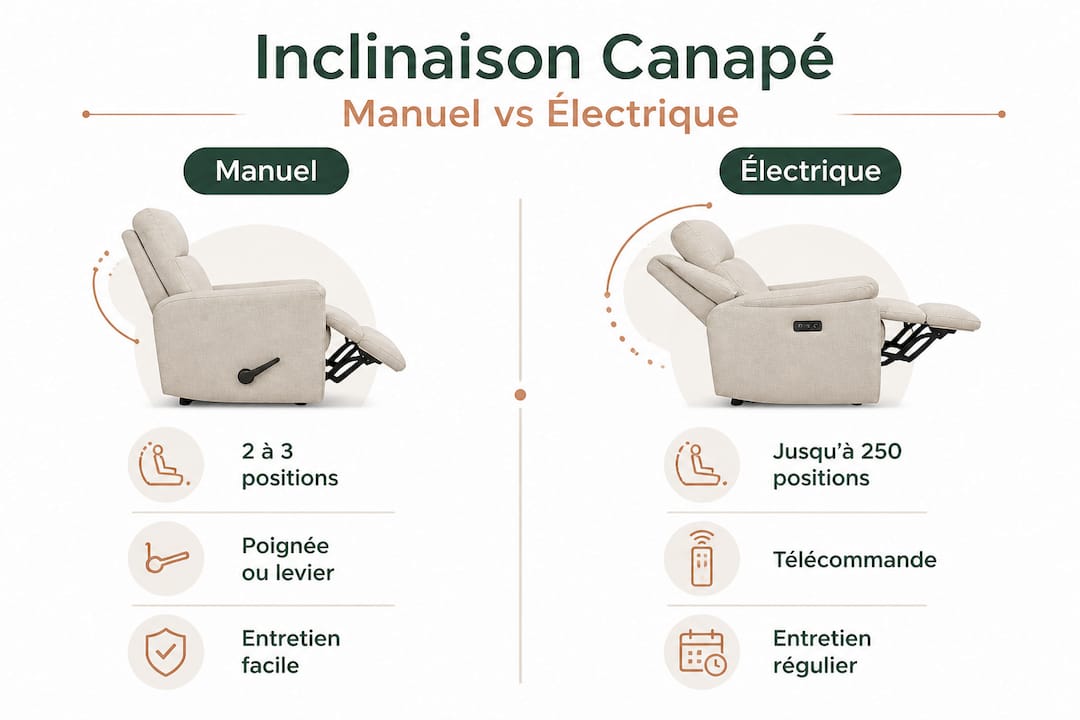
There are two main types of reclining mechanisms. Manual systems work with a side handle or lever. You pull, the backrest tilts, and you release to lock. Simple, but limited: generally, you'll have two or three fixed positions, with little fine-tuning between the upright sitting position and almost fully reclined.
Electric systems, on the other hand, use an integrated motor controlled by a remote or a button panel. The movement is smooth and continuous. Up to 250 positions are available on some electric models, compared to two or three on manual ones. This is not a gimmick: for someone suffering from back pain or looking for the perfect support for reading, this precision makes a real difference.
| Criterion | Manual | Electric |
|---|---|---|
| Number of positions | 2 to 3 | Up to 250 |
| Maintenance | Cable check | Motor and power supply check |
| Average price | More accessible | Generally higher |
| Ease of use | Requires physical effort | Very simple, one press is enough |
| Suitable for | Occasional users | Intensive daily use |
Manual systems are well-suited for people who don't need to fine-tune their position every evening. Electric ones are essential for regular use, especially if several people share the sofa and each have their preferences. To choose wisely, you can explore the reclining systems depending on the sofa and the criteria for an elegant sofa that remains functional in an apartment.
Necessary Equipment and Space Preparation
Once the mechanism type is identified, prepare the space and equipment.
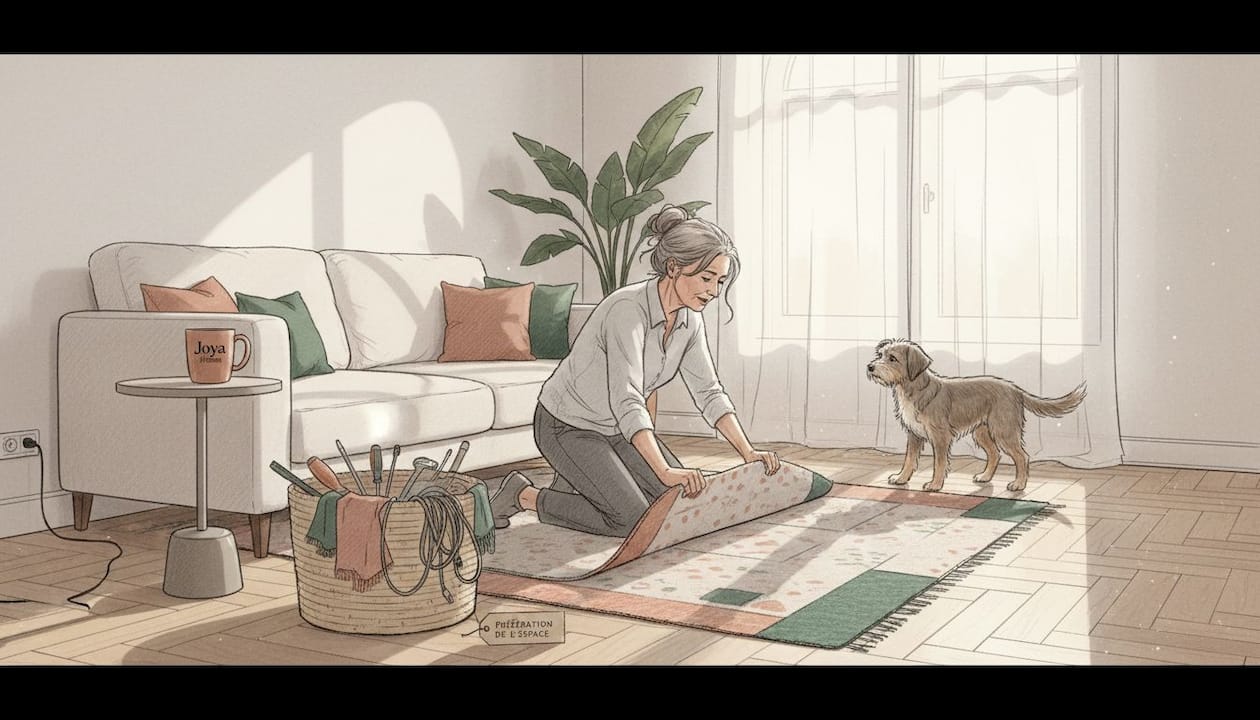
Many people skip this step and quickly regret it. An adjustment made in too cramped a space can block the mechanism or scratch the wall behind the sofa. Here's what you'll need depending on your system type:
For a manual sofa:
- A flat-head screwdriver and a Phillips head screwdriver
- A flashlight to inspect under the structure
- Protective gloves for maneuvers under the chassis
- A tape measure
For an electric sofa:
- An accessible and functional power strip
- The remote control (or control cable) for the model
- A multimeter if you suspect a power supply issue
- The manufacturer's manual (model number often found under the sofa)
| Operation | Required tool | Estimated duration |
|---|---|---|
| Mechanism inspection | Flashlight | 5 minutes |
| Manual position test | None | 2 minutes |
| Power supply verification | Multimeter | 10 minutes |
| Clearing rear space | Tape measure | 3 minutes |
Space preparation is often overlooked, but it is crucial. You need to allow at least 40 cm behind the sofa to allow the backrest to recline without hitting the wall. In a small apartment, this sometimes means moving the sofa a few tens of centimeters. To easily install a corner sofa in a compact space, also consider optimizing your living room space before any manipulation.
Pro tip: Slide an old folded sheet under the sofa legs before moving it. This protects your parquet or tiles and prevents scratching the floor during position adjustments.
Detailed Steps for Adjusting Your Sofa's Recline
The space is ready; here's how to proceed with the adjustment step-by-step.
For an electric reclining sofa:
- Plug in the sofa and ensure the power indicator light is on.
- Press the up or down button for two seconds to initialize the motor.
- Move gradually in small pulses to test each position.
- Once the ideal position is found, release. Some models memorize up to three favorite positions.
- Test the full recline position to check that no obstacles hinder the movement.
For a manual reclining sofa:
- Sitting in the sofa, locate the side handle (often under the right armrest).
- Grasp it firmly and pull it towards you while lightly leaning back with your weight.
- Recline the backrest to the desired position, then gently release the handle.
- Test stability by leaning slightly forward. The position should hold without slipping.
- To return to the sitting position, lean forward and bring the backrest back with light pressure.
To adjust an electric reclining sofa, the remote control handles everything; for a manual one, regularly check the handles and cables to prevent wear. Joya Home's SoftRecover technology perfectly illustrates this logic of a smooth and controlled return to position, without sudden jerks or abrupt resistance. To further enhance your experience, some accessories to improve comfort complement recline adjustment by better supporting the lumbar region.
Pro tip: Never force a manual handle if it resists. A defective cable is detected by a loose handle that returns without engaging the backrest. If this is the case, stop immediately and check the cables.
Troubleshooting and Common Mistakes to Avoid
Despite these steps, the sofa may still resist. Here's how to react intelligently.
Many people's first instinct is to force it. This is the worst mistake. On a manual system, forcing a handle that resists can break the pull cable or deform the tilting axis. On an electric one, repeatedly pressing the remote control without result can overheat the motor.
Common symptoms and their interpretation:
- Handle with no resistance that returns empty: broken cable or detached from its anchor point
- Backrest that does not return to the upright position: fatigued or disconnected return spring
- Squeaking noise during movement: rotation axis needs lubrication with silicone grease
- Remote control without effect: check the battery, then test the sofa's power supply
- Motor humming without moving the backrest: mechanical obstruction to identify under the chassis
"Reliability trap, especially with manual systems: check cables and controls before concluding a total breakdown."
The most common mistake in apartments remains not checking the available space behind. The backrest hits the wall, the motor forces, and the user believes there's a malfunction when the sofa is simply poorly positioned. Consult the user guide for compact sofas if you have a compact model and want to avoid this type of classic mistake.
Visual Summary: Procedure Overview by System
To ensure nothing is forgotten, here's a clear summary of all the steps.
| Step | Manual sofa | Electric sofa |
|---|---|---|
| Preparation | Check cables and handles | Check power supply and remote control |
| Required space | Minimum 40 cm at the back | Minimum 40 cm at the back |
| Activation | Pull the side handle | Press the control button |
| Fine adjustment | 2 to 3 available notches | Continuous adjustment |
| Return to sitting position | Forward pressure | Return button |
| Post-use check | Cable, spring, axis | Power supply, motor, remote control |
| In case of blockage | Do not force, inspect cables | Do not repeat command, cut power |
This table summarizes the essentials. Keep it handy, especially during the first few weeks of using a new sofa.
Our Expert View on Recline Adjustment
Beyond the user manual, let's take a step back: what should we remember for a more pleasant living room every day?
Here's a truth no one says enough: a sofa with 250 positions is useless if the basic structure doesn't properly support your lower back. We regularly see people invest in sophisticated electric models, then remain uncomfortable because the seat foam is too soft or too firm for their body type. The recline adjusts the angle; it doesn't compensate for poor basic ergonomics.
The number one mistake among young apartment renters is choosing an imposing reclining sofa because it seems "ultra comfortable in the store," without considering the real constraints: the space needed to recline the backrest, the weight to move for cleaning behind it, or the visual aspect when the backrest is reclined at 45 degrees right in the middle of the living room.
True comfort comes less from the number of positions than from the simplicity and fluidity of adjustment. A mechanism that you hesitate to use because it's complicated or noisy won't add anything to your actual comfort. In a studio or one-bedroom apartment, we often recommend simple, responsive, and quiet systems rather than mechanisms loaded with functions you'll never use.
For apartments, the approach that works best combines comfort and modern design with an accessible mechanism. A sofa you want to use every evening is infinitely better than an overly complex model that always ends up in the upright sitting position by default.
Make a Smart Purchase with an Easy-Adjustable Sofa
To fully enjoy the adjustments and a successful living room, choose a well-designed model from the moment of purchase.
Knowing the reclining mechanisms is good. Choosing a sofa designed to make this experience intuitive and adapted to your space is even better. At Joya Home, each model is designed for real apartment living: simplified delivery thanks to the advantages of compressed sofas, quick installation without complex tools, and a range of high-end sofas that combines corduroy aesthetics with everyday practicality.

If your living room is compact, discover our sofas for small spaces specially designed to maximize comfort without encroaching on your living space. Order in a few clicks, receive your sofa packaged in a compact box, and install it stress-free from the very first hour.
Frequently Asked Questions about Sofa Recline Adjustment
What are the signs of a defective cable on a manual sofa?
A handle that no longer offers resistance and returns without actuating the backrest often indicates a broken or disengaged cable. This symptom is confirmed by the fact that a defective cable is detected by a loose handle with no mechanical feedback.
Should you leave space behind your electric reclining sofa?
Yes, you should allow at least 40 cm at the back to allow the backrest to recline without hindering movement or damaging the wall.
How many different positions does a modern electric reclining sofa offer?
Some models offer up to 250 positions, far more than a classic manual one limited to two or three fixed notches.
Can you adjust your sofa's recline alone, or do you need two people?
Electric adjustment can generally be done alone using the remote control. For bulky manual systems, having two people is sometimes safer to avoid any risk of pinching or uncontrolled tilting.
Recommendation
- Installing a Corner Sofa: Easy Step-by-Step Guide – Joya Home
- 3-2-1 Method: Adapting Your Designer Sofa to the Living Room – Joya Home
- Practical Sofa Accessories: Boost Comfort and Style – Joya Home
- Le Reverso - Convertible Sofa in Ultra-Soft Corduroy – Joya Home
- How to choose bedding for stylish comfort at home – Roomie Design