

TL;DR:
- Eco-friendly furniture aims to reduce environmental impact throughout its life cycle, prioritizing eco-design, durability, and end-of-life management. FSC, PEFC, and OEKO-TEX labels ensure traceability, material durability, and the absence of harmful substances. The AGEC law promotes reuse and recycled materials, thus stimulating the industry towards more sustainable practices.
Eco-friendly furniture refers to furniture designed to reduce its environmental impact throughout its entire life cycle, from the extraction of raw materials to its end-of-life. These sustainable pieces combine certified materials, energy-efficient manufacturing processes, and optimized longevity. In France, regulatory frameworks like the AGEC law and labels such as FSC or PEFC now structure this sector. Understanding this definition also means grasping why simply choosing "natural" wood is not enough to qualify a piece of furniture as ecological.
What is the definition of eco-friendly furniture?
Eco-friendly furniture is based on three complementary dimensions that the general public too often confuses. Eco-design, service life, and end-of-life management are distinct but inseparable for reducing the actual environmental impact of a piece of furniture.
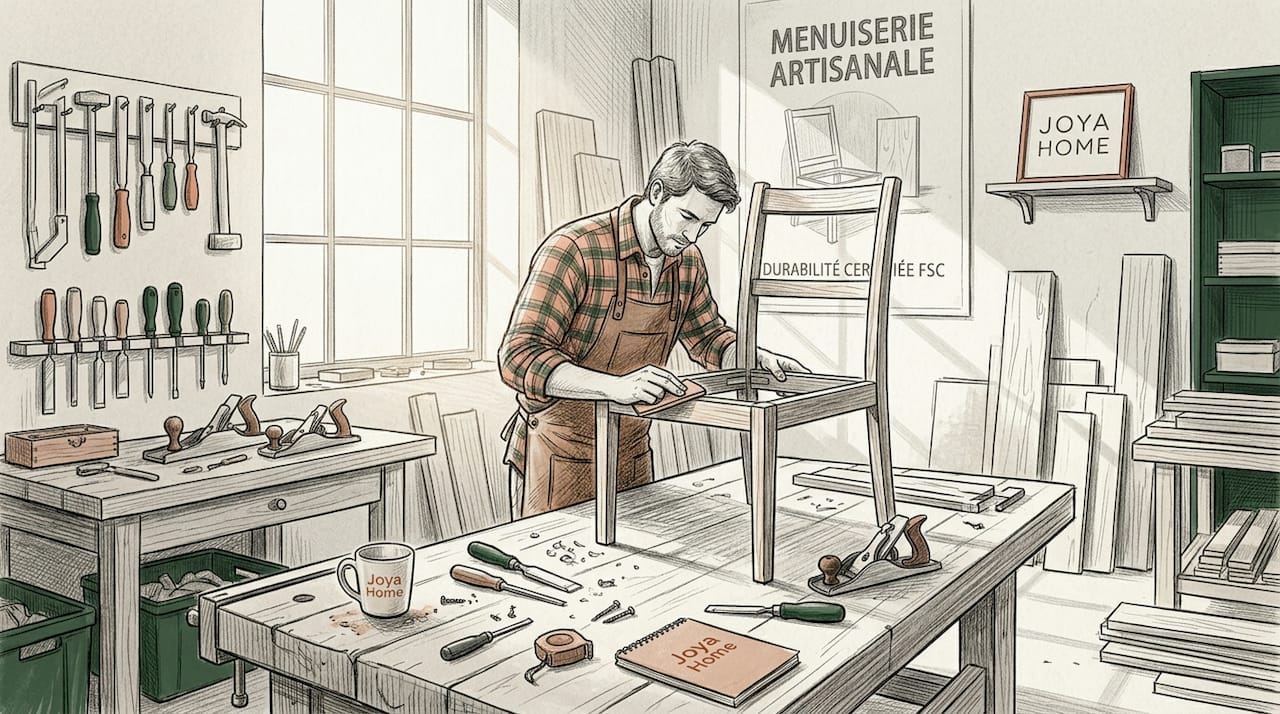
Eco-design intervenes from the product design phase. It consists of selecting materials with lower impacts, reducing the amount of material used, and optimizing manufacturing processes with low energy consumption, while limiting harmful substances. A manufacturer who replaces chemical glue with water-based glue, or who designs demountable assemblies, practices concrete eco-design.
Service life concerns the longevity of the furniture once it is in your home. A repairable sofa, whose parts are standardized and available, has a much lower carbon impact than a "green" model discarded after five years. End-of-life management covers reuse, re-purposing, and recycling, governed in France by the AGEC law.
Pro tip: Before buying a piece of furniture presented as eco-friendly, ask the seller if spare parts are available and for how many years. This is the quickest test to assess its real service life.
What are the fundamental principles of eco-friendly furniture?
The principles of eco-friendly furniture are rooted in the 7 pillars of the circular economy, which include eco-design, responsible consumption, extended service life, and recycling. Here are the four most concrete levers for furniture:
- Material selection: FSC or PEFC certified wood, fast-growing bamboo, recycled materials such as recovered plastic or second-hand textiles. Each material is evaluated based on its carbon footprint, toxicity, and renewability.
- Manufacturing optimization: reduction of material waste, use of renewable energy in factories, limitation of intermediate transport. ADEME lists 42 eco-design levers spread across 8 axes of the life cycle to improve the environmental performance of products.
- Responsible consumption: buying less but better, opting for modular or evolving furniture rather than disposable items. A modular sofa that adapts to a move avoids an additional purchase.
- Applied circular economy: designing for reuse, facilitating disassembly, using recycled materials. Since 2024, the AGEC law requires public buyers to purchase a minimum of 20% furniture from reuse or incorporating recycled materials. This legal obligation signals that the public sector is now a driver of demand for recyclable furniture.
How to recognize eco-friendly furniture?
Recognizing truly eco-friendly furniture requires looking beyond marketing claims. Several concrete criteria make it possible to distinguish a genuine commitment from a simple communication stunt.
| Criterion | What it guarantees |
|---|---|
| FSC or PEFC label | Wood from sustainably managed forests, with verified traceability |
| Certified recycled materials | Proportion of recycled material attested by an independent third party |
| Local or regional origin | Reduction of carbon footprint related to transport |
| Available spare parts | Effective longevity and reparability of the product |
| End-of-life attestation | Proof of reuse or recycling channel at the end of use |
FSC and PEFC labels remain the most reliable references for wood. They guarantee responsible forest management and supply chain traceability. For textiles and fillings, look for certifications like OEKO-TEX, which certifies the absence of harmful substances.
Geographical traceability also matters. Furniture made in Europe with local wood generates fewer CO2 emissions than an identical model produced in Southeast Asia, even if the latter displays a green label. To ensure the credibility of eco-friendly furniture, it must be possible to justify its end-of-life management with tangible evidence, via validated certifications or attestations.
A well-designed eco-friendly sofa combines these criteria: certified materials, efficient manufacturing, and a structure designed to last or be repaired.
What are the advantages of eco-friendly furniture?
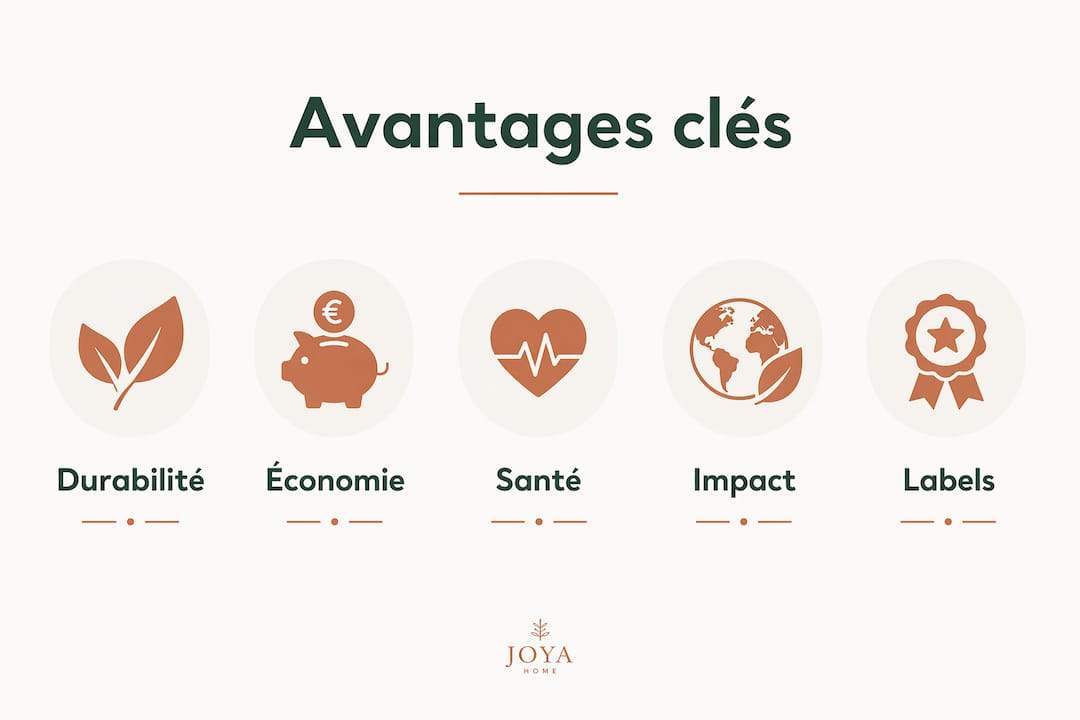
The advantages of sustainable furniture go beyond mere environmental protection. They also affect your wallet and your quality of life in the long term.
Environmentally, choosing sustainable furniture directly reduces greenhouse gas emissions related to production and transport. The carbon impact is mainly reduced by optimizing service life and limiting waste during manufacturing. Without longevity, the ecological benefit remains limited, even with recognized labels like FSC or PEFC. This point is often underestimated by consumers who focus solely on the origin of materials.
Economically, a higher quality piece of furniture often costs more upfront, but its total cost over ten years is lower than that of three inexpensive pieces of furniture replaced successively. Reparability reduces unforeseen expenses. A sofa whose cushions are replaceable or whose structure is guaranteed for ten years represents real savings.
From a health perspective, eco-friendly furniture limits harmful substances such as formaldehydes present in some cheap particle boards. This improves indoor air quality, a public health issue often neglected in furniture choices.
What are the current challenges for eco-friendly furniture?
The main obstacle remains the absence of a unique European definition. Two products described as eco-friendly can be difficult to compare without detailed data on their complete life cycle. This lack of a common standard opens the door to greenwashing, a practice that consists of displaying ecological arguments without justifying them with verifiable evidence.
Evaluating the complete life cycle of furniture remains complex and costly for manufacturers. It requires modeling the impact of each stage, from raw material extraction to end-of-life collection. Few brands publish these analyses transparently and accessibly to the general public.
Reparability is often overlooked in brand communication, even though it represents one of the most powerful levers for reducing actual environmental impact. Furniture designed with recycled materials but impossible to repair remains a single-use resource.
Pro tip: Be wary of vague claims such as "made with natural materials" or "environmentally friendly" without third-party certification. Always demand a recognized label or a technical sheet detailing the materials and their origin.
Key points
Eco-friendly furniture is not defined by a single criterion but by the combination of eco-design, service life, and traceable end-of-life management.
| Point | Details |
|---|---|
| Multidimensional definition | Eco-friendly furniture covers eco-design, longevity, and end-of-life management. |
| Reference labels | FSC, PEFC, and OEKO-TEX are the most reliable certifications for verifying commitments. |
| French legal framework | The AGEC law requires 20% recycled or reused furniture in public procurement since 2024. |
| Longevity above all | Without optimized service life, the ecological benefit remains limited even with certified materials. |
| Greenwashing vigilance | In the absence of a unique European standard, demanding tangible proof remains essential. |
What I learned observing the sustainable furniture market
Most articles on eco-friendly furniture stop at materials. FSC wood, bamboo, recycled. This is the visible part, but it's rarely where the main impact lies.
What struck me following this sector is that service life is the most underestimated lever. A sofa made with ordinary materials but designed to last twenty years, repairable, with available parts, often beats a "green" model replaced after five years. The carbon footprint per year of use is the right indicator, not the label on the product sheet.
I am also convinced that the AGEC law is a real turning point, not just another administrative constraint. When the public sector commits to buying 20% recycled or reused furniture, it creates a structural demand that forces manufacturers to invest in serious channels. This is exactly the type of signal that moves industrial practices faster than any awareness campaign.
For individuals, my advice is simple: ask two questions before buying. How long can this piece of furniture last? And what happens when it's worn out? If the seller can't answer, move on.
— Charles
Joya-home: compressed sofas designed to last
At Joya-home, durability is not limited to material selection. Compressed sofa technology directly reduces the carbon footprint associated with transport and storage, by compacting each sofa into a carton deliverable without specialized trucks. Less volume transported means fewer emissions per delivery. Models like Le Méridia and Le Reverso are designed with quality corduroy, with a structure built for longevity.
If you're looking for a durable compressed sofa that combines design, comfort, and reduced impact, discover the Joya-home range. You'll also find a complete guide on the advantages of compression for ecology, to understand how this format concretely changes the environmental equation of living room furniture.
FAQ
What exactly is eco-friendly furniture?
Eco-friendly furniture refers to furniture designed to minimize its environmental impact throughout its life cycle, combining sustainable materials, efficient manufacturing, and traceable end-of-life management. This definition is based on the principles of eco-design and the circular economy.
Which labels guarantee truly eco-friendly furniture?
FSC and PEFC labels certify the sustainable origin of wood, while OEKO-TEX certifies the absence of harmful substances in textiles. These third-party certifications remain the most reliable evidence against unverified marketing claims.
Does the AGEC law concern individuals?
The AGEC law directly applies to public buyers, who must integrate 20% recycled or reused furniture into their procurements since 2024. For individuals, it indirectly creates a broader supply of recyclable furniture on the market.
Does eco-friendly furniture cost more?
The purchase price is often higher, but the total cost over the furniture's lifespan is generally lower due to longevity and reparability. A durable piece of furniture replaced only once costs less than a cheap model renewed three times.
How to avoid greenwashing in furniture?
Demand recognized certifications such as FSC, PEFC, or OEKO-TEX, and ask for a technical sheet detailing materials and their origin. In the absence of a unique European standard, only tangible evidence can distinguish a real commitment from a simple commercial promise.