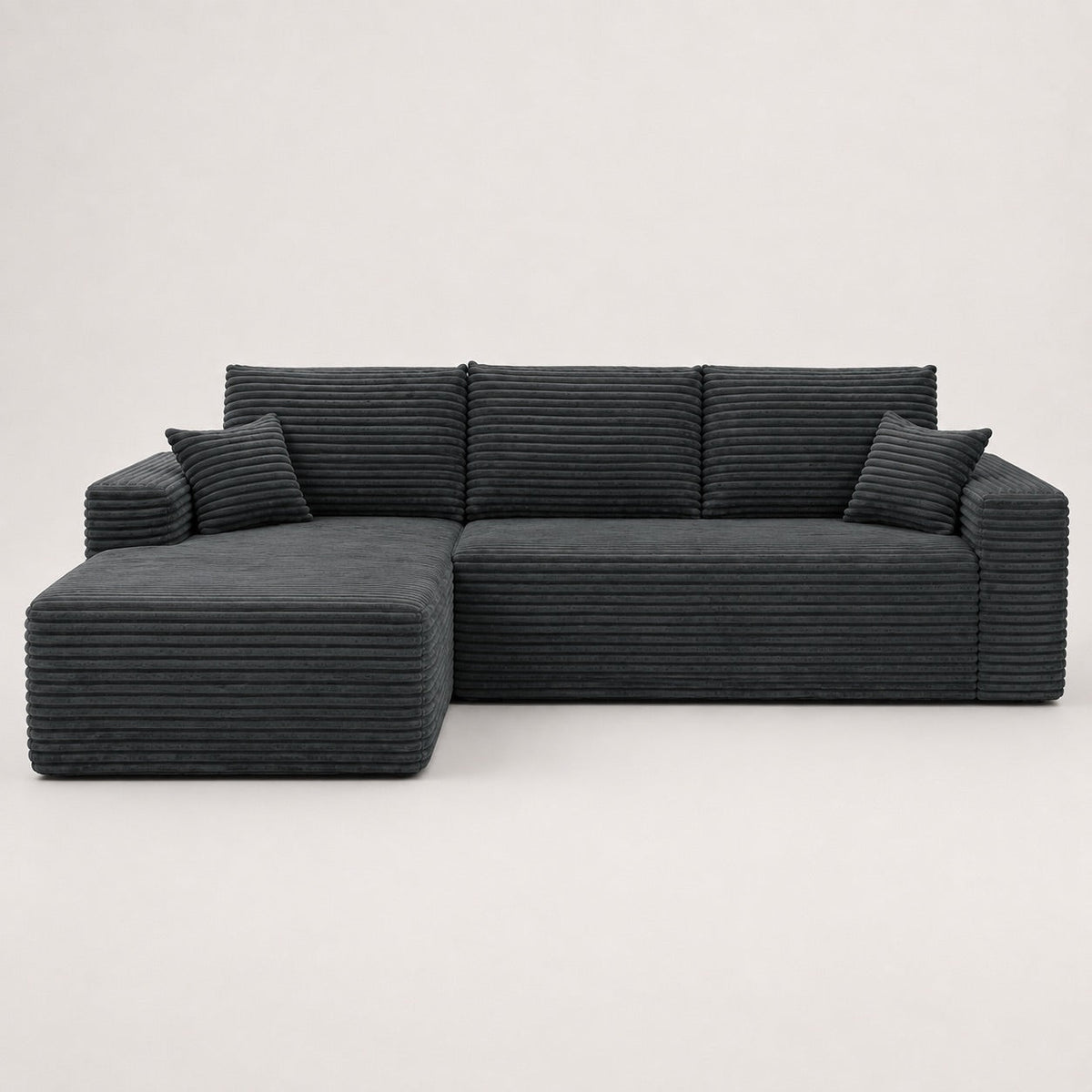

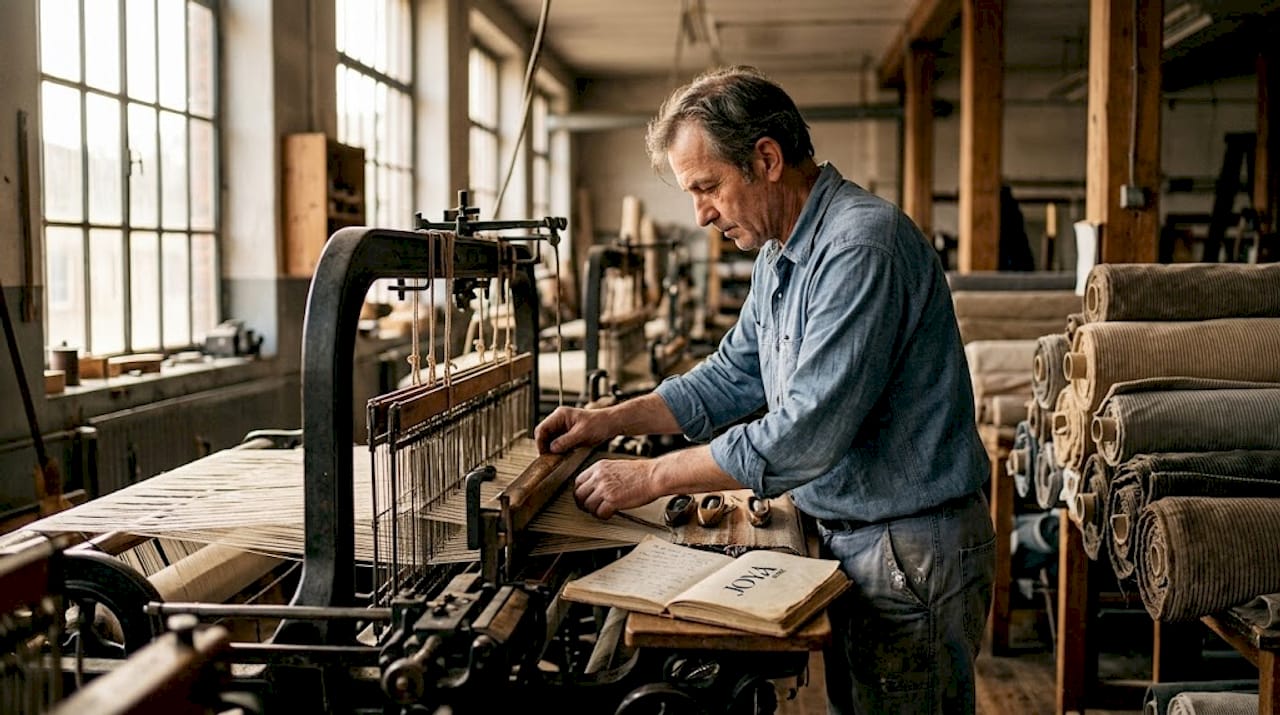
TL;DR:
- Corduroy originates from Egyptian fustian dating back to the 2nd century AD.
- Its complex weave creates vertical wales, offering durability and wear resistance.
- Today, it is prized in interior design for its textured appearance and ability to hide wear and tear.
Corduroy is often associated with retro jackets from the 70s, but its history began much earlier, and much further away. Many believe its name comes from the English phrase “cord of the king,” a flattering but entirely invented etymology. In reality, this fabric originates from fustian developed in the 2nd century AD near Cairo, Egypt. Today, this same fabric is making a strong comeback in interior design, particularly for contemporary sofas. Let's look back at its fascinating journey, from its ancient origins to its place in our modern living rooms.
Table of Contents
- A fabric from Egypt: From ancient beginnings to fustian
- Understanding corduroy weaving and manufacturing
- From robust textile to contemporary design: The evolution of corduroy
- Essential criteria for choosing a corduroy sofa
- Why corduroy is the secret weapon of the modern sofa
- Find your ideal corduroy sofa with Joya Home
- Frequently asked questions about corduroy
Key Points
| Point | Details |
|---|---|
| Ancient origin | Corduroy originates from fustian developed in Egypt in the 2nd century AD. |
| Unique manufacturing | Its weave and vertical wales create a resistant and elegant texture suitable for sofas. |
| Variety of styles | Fine wales for modern design, wide for vintage style, each type impacts appearance and durability. |
| Contemporary use | Corduroy enhances sofas by providing visual warmth, comfort, and wear resistance. |
A fabric from Egypt: From ancient beginnings to fustian
Before becoming a decor trend, corduroy was a survival fabric. Its origins date back to fustian, a robust fabric manufactured in the 2nd century near Cairo. This blended fabric, often composed of linen and cotton, was designed to withstand intense use. It was anything but luxurious, but it was indestructible.
This fustian traveled to Europe via Mediterranean trade routes. Arab, then Italian merchants, spread it across the continent. Over the centuries, European artisans refined the technique, playing with thread density and loop cutting to create increasingly elaborate surface effects.
It was in England, in the 18th century, that corduroy took its modern form. The industrial revolution allowed for the mechanization of weaving, standardization of wales, and mass production of the fabric. It then became the clothing of workers, miners, and farmers, appreciated for its warmth and durability.
“Corduroy, often presented as a royal fabric, was actually born in the hands of workers, not in palaces.”
The myth of the “king's cord” is a popular invention. The English expression “corduroy” would rather come from the word “duroy,” a coarse woolen fabric manufactured in England in the 17th century. No one knows for sure how the confusion set in, but it persists.
Here are the key moments in this historical evolution:
- 2nd century AD: appearance of fustian in Egypt, direct ancestor of corduroy
- Middle Ages: spread in Europe via Arab and Italian trade routes
- 17th century: development of “duroy” in England, a ribbed woolen fabric
- 18th century: mechanization of weaving, standardization of wales, popularization among workers
- 19th century: adoption by middle classes, diversification of uses
- 20th century: appropriation by youth culture and counter-cultural movements
This history of corduroy shows a fabric that has always reinvented itself without betraying its roots.
Understanding corduroy weaving and manufacturing
To understand why corduroy is so special, you need to look at how it's made. It's not an ordinary fabric. Its manufacturing process involves weaving with extra threads forming loops, which are then cut after bonding to create the characteristic vertical wales. It is this precise cut that gives the fabric its recognizable appearance and feel.
The manufacturing steps unfold in a precise order:
- Base weaving: a solid fabric base is created with warp and weft threads
- Insertion of floating threads: extra threads are woven into loops on the surface
- Bonding the loops: a temporary adhesive fixes the loops to facilitate cutting
- Cutting the loops: a blade slices the loops to create the vertical wales
- Brushing: the wales are brushed to open the fibers and create a velvety feel
- Dyeing and finishing: the fabric is dyed, washed, and treated to stabilize the wales
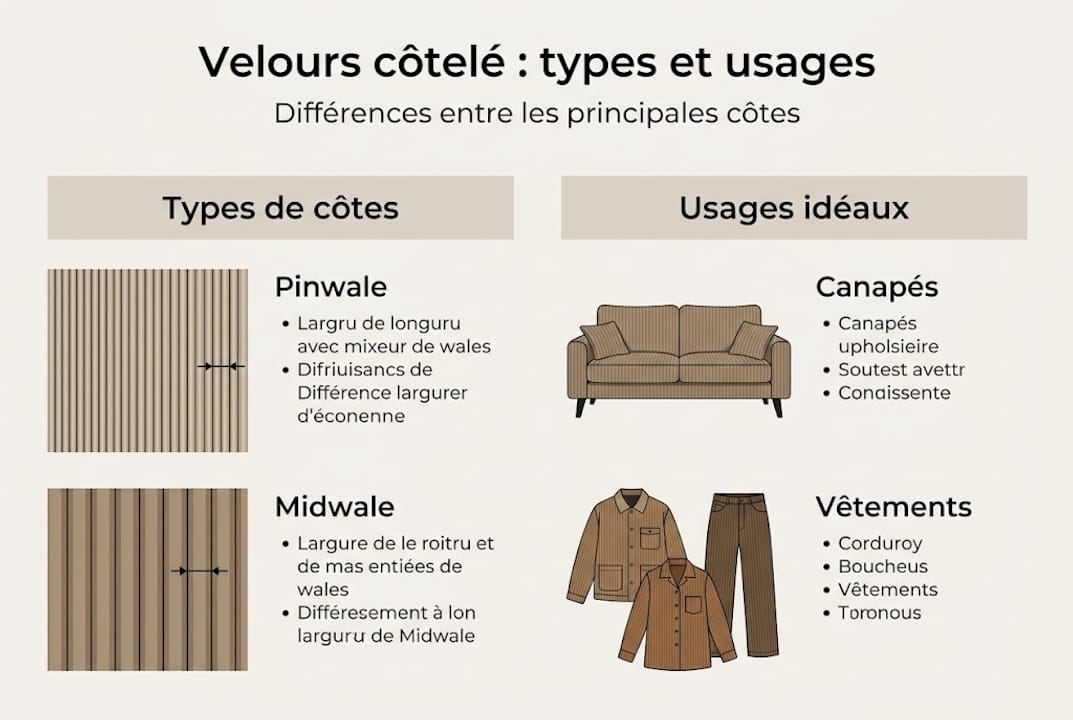
The final result largely depends on the width of the wales. The three main types are pinwale, midwale, and widewale, each with its own visual and practical characteristics.
| Wale type | Number of wales per cm | Visual effect | Ideal use |
|---|---|---|---|
| Pinwale | 6 to 10 | Fine, elegant, discreet | Modern, minimalist style |
| Midwale | 3 to 5 | Balanced, versatile | Everyday use, family sofas |
| Widewale | 1 to 2 | Pronounced, graphic, retro | Vintage style, statement pieces |
For a sofa, the corduroy weave and finish directly influence durability and comfort. A well-finished fabric resists repeated rubbing better and retains its appearance longer.
Pro tip: For a sofa for daily use, prefer a midwale with a high thread density. The advantages of corduroy for the living room are maximized with a fabric whose wales are tightly spaced, as they resist deformation better and maintain their shape after years of use.
From robust textile to contemporary design: The evolution of corduroy
Corduroy took a long time to enter living rooms. For centuries, it was reserved for work clothes. Then, in the 60s and 70s, counter-cultural movements adopted it as a symbol of simplicity and authenticity. This reappropriation changed its perception forever.
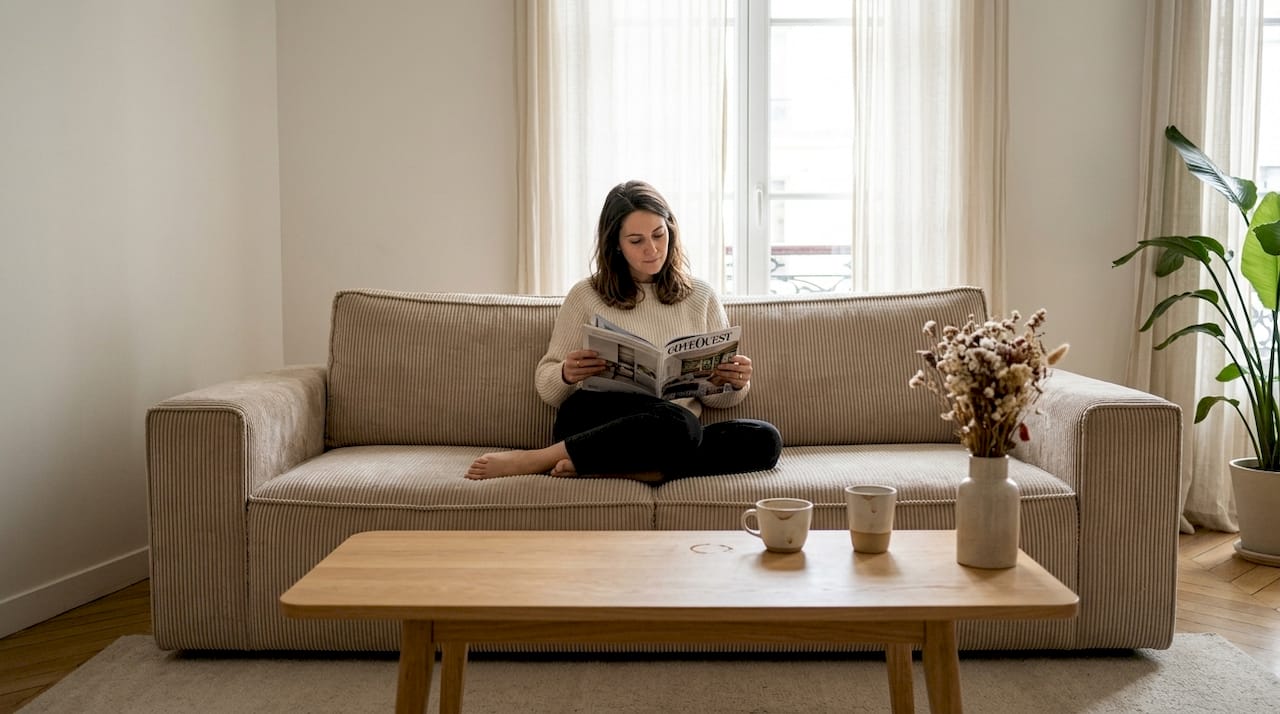
Today, in contemporary sofa design, corduroy brings texture, visual warmth, wear resistance, and a highly sought-after retro-modern effect. It is no longer perceived as an ordinary fabric but as a strong choice, a style statement.
The ribbed texture plays a fascinating optical role. Depending on the angle of light, the wales absorb or reflect rays differently, creating a depth effect that changes throughout the day. A corduroy sofa does not look the same in the morning as it does in the evening. This is a rare quality in furniture.
“Corduroy transforms an ordinary sofa into a statement piece, simply by the play of light on its wales.”
Here's why this fabric is asserting itself in modern interior design:
- Hides wear and tear: wales conceal friction marks better than smooth fabric
- Hygge effect: the soft, warm texture creates an immediate cozy atmosphere
- Stylistic versatility: adapts to Scandinavian, industrial, bohemian, or classic styles
- Resistance: dense fibers withstand intense daily use
- Play of light: the changing effect depending on the angle gives movement to the room
| Decor style | Recommended wale type | Trendy color |
|---|---|---|
| Modern minimalist | Pinwale | Light grey, beige, off-white |
| Vintage retro | Widewale | Terracotta, mustard, sage green |
| Scandinavian | Midwale | Navy blue, anthracite grey |
| Bohemian | Widewale | Ochre, brown, rust |
Corduroy has evolved from a robust work fabric to a key element of contemporary interior design. To explore concrete combinations, the corduroy decor ideas and the types of corduroy corner sofas available today show how well this fabric adapts to all interiors.
Essential criteria for choosing a corduroy sofa
Choosing a corduroy sofa is not just about color. Several technical criteria directly influence your long-term satisfaction. Here's how to approach this choice methodically.
- Choose wale width according to your style: fine wales suit modern minimalist designs, while wide ones reinforce a vintage style. This choice also impacts durability, as wide wales tend to flatten faster under pressure.
- Evaluate fabric density: dense corduroy resists friction better. Run your hand against the nap: if the fibers straighten easily, the fabric is of good quality.
- Check fiber composition: pure cotton is breathable and natural, but a cotton-polyester blend offers better wear resistance for a family sofa.
- Anticipate maintenance: corduroy should be cleaned with a soft brush against the nap. Avoid abrasive products that crush the fibers.
- Harmonize with your existing decor: test samples in your room at different times to observe the effect of natural light on the wales.
Pro tip: Before buying, consult a corduroy sofa buying guide to compare models according to your priorities. Criteria for an elegant sofa vary depending on the size of your room and your lifestyle. A velvet sofa enhancement guide can also help you get the most out of your purchase in the long run.
The durability of a corduroy sofa depends as much on the fabric as on the structure. A solid wood or quality plywood frame extends the life of the furniture far beyond the fabric itself. Don't sacrifice the structure to save on price.
Why corduroy is the secret weapon of the modern sofa
Many people choose corduroy for its aesthetics, and that's a good reason. But it's not the best one. The true strength of this fabric is its ability to hide wear and tear, play with light, and create a lasting hygge effect that few fabrics can match.
Smooth fabrics show every mark, every snag, every deformation. Corduroy, on the other hand, visually absorbs these imperfections into its wales. A well-maintained corduroy sofa looks new much longer than a flat fabric or synthetic leather sofa.
We also believe that corduroy is not a passing fad. Its return to interiors is not a stylistic whim; it is a response to a real need for warmth, texture, and authenticity in spaces that are often too smooth. To harmonize a velvet sofa decor with the rest of your interior, opt for complementary natural materials such as wood, linen, or rattan. Corduroy does not seek to dominate a room. It enriches it.
Find your ideal corduroy sofa with Joya Home
After exploring the history and properties of corduroy, it's time to take action. At Joya Home, we offer a collection of corduroy sofas designed to combine style, comfort, and everyday practicality.
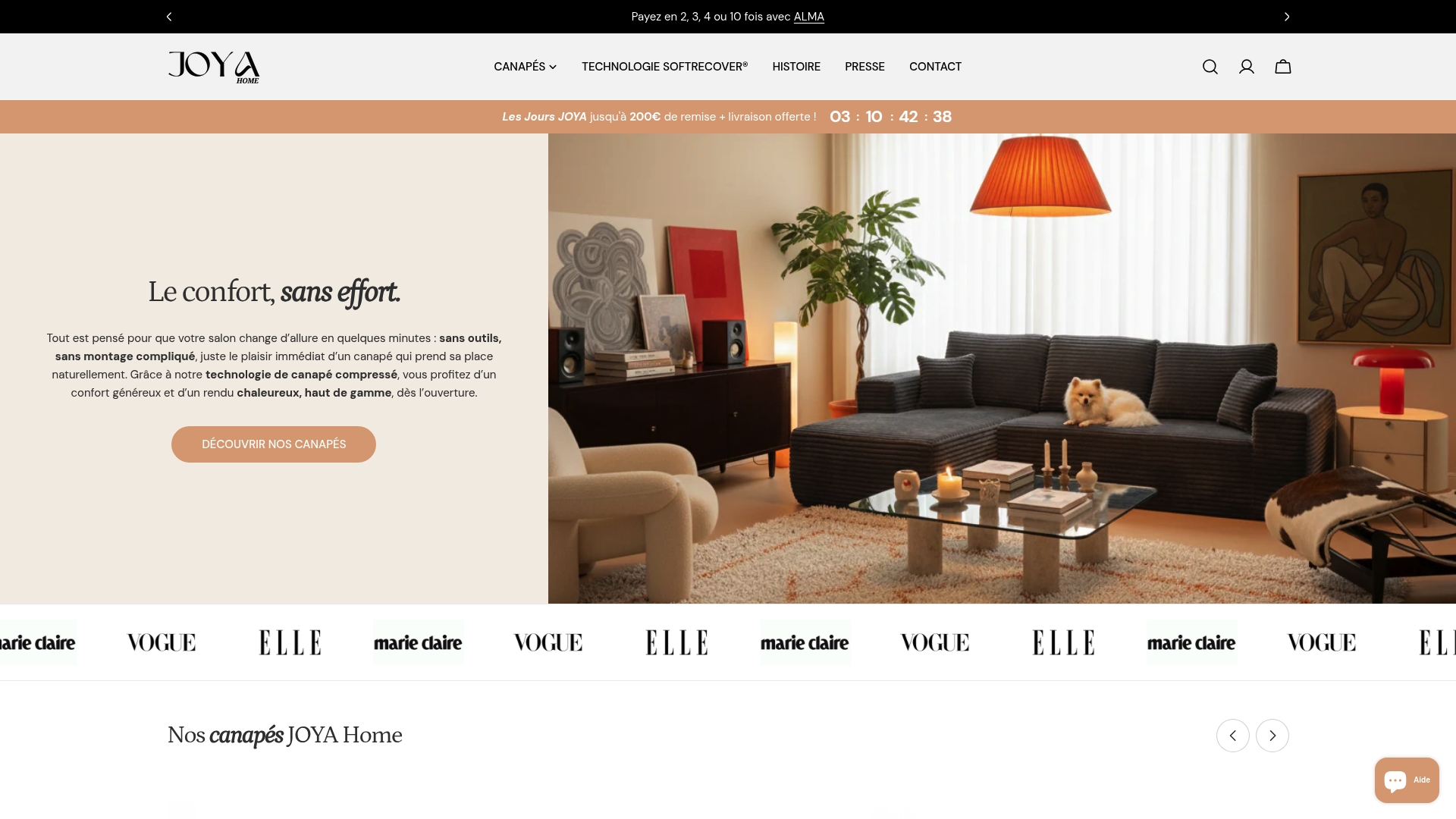
Our compressed sofa technology allows for simplified delivery directly to your home, without the usual constraints of large furniture transport. Models like Le Méridia and Le Reverso are made with corduroy fabrics selected for their density and durability. For an informed purchase, discover our commitments to high-end, durable, and comfortable sofas and find the model that perfectly matches your interior.
Frequently asked questions about corduroy
Where does the name 'corduroy' come from and what is its link with the 'cord of the king' myth?
The term 'corduroy' simply describes the vertical ribbed pattern of the fabric, while "cord of the king" is an English myth without historical basis, probably a confusion with the word "duroy," an ancient English wool fabric.
What are the main varieties of corduroy used for modern sofas?
There are three main types: pinwale, midwale, and widewale, each offering a different visual rendering and durability depending on the width and density of the wales.
Is corduroy easy to maintain on a sofa?
Yes, its ribbed texture naturally hides signs of wear, but it's best to brush it regularly against the nap and avoid abrasive cleaners.
How to choose between fine and wide wales for a corduroy sofa?
Fine wales suit a modern and minimalist style, while wide wales enhance a vintage effect, with a direct impact on the durability and overall aesthetic of the furniture.
Recommendation
- Corduroy, a material making a comeback in our interiors – Joya Home
- Corduroy: the history of a popular fabric that became a decor icon – Joya Home
- Enhance your modern interior with velvet: style and comfort – Joya Home
- Enhance your living room with corduroy in 2026 – Joya Home
- Coastal decor explained: Create relaxed, beach-inspired spaces – New Way Ref